
Key Takeaways
Turning radius means how much room your wheelchair or scooter needs to turn all the way around. It affects how well you can move in small spaces.
Mid-wheel drive devices have the smallest turning radius. This makes them best for using indoors and in tight spots.
can turn more sharply and fit better inside. Four-wheel scooters are steadier outside but need more space to turn.
A smaller turning radius helps you move around furniture, go through doors, and use elevators more easily. This gives you more independence.
Think about your daily routine and where you use your device most. This helps you choose the right turning radius and drive type for your needs.
Adjustable settings, smart technology, and safety features help you control better. They also make you feel more comfortable and confident when turning and moving.
Practice using your device often and take care of it. This keeps turning smooth and safe.
Try out different models in places you use every day. This helps you find the device that is easiest and most comfortable for you to control.
Turning Radius Basics
What Is Turning Radius
Turning radius shows how much space your needs to turn all the way around. You find this by measuring the smallest circle the device can turn inside. This helps you know if you can move in small places, like hallways or elevators.
The .
Different wheel spots change how tightly you can turn. For example, than front-wheel drive ones.
There is not one set number for turning radius, but most companies use the size and shape of the device to explain it.
Here is a table with :
| Device Type | Typical Turning Radius (inches) | Additional Notes |
|---|---|---|
| Electric Wheelchairs | As little as 20 | Can turn in a 40 inch space; tightest turning radius among devices |
| Wheelchairs (general) | Minimum radius of 30 | Need less space than scooters |
| Electric Wheelchairs/Scooters/Reclining Wheelchairs | Minimum radius of 47 | Minimum diameter needed is 94 inches |
| Mobility Scooters | Larger than wheelchairs | Usually need more room; small 3-wheel models turn tighter for indoor use |
| WHILL Model C2 | 30 | Very easy to move in tight spaces and has special features |
Why It Matters
Turning radius changes how you move every day. If your device has a small turning radius, you can go around corners, enter rooms, and fit in elevators more easily. You do not need to back up or make lots of small turns.
A small turning radius lets you turn and move in tight spaces.
You can get close to tables, counters, and doors without trouble.
Devices with settings for turning radius help you move better in different places.
Tip: If you use your wheelchair or scooter inside a lot, pick a model with a small turning radius. This helps you move easily at home, work, or in public places.
Common Myths
Some people believe things about turning radius that are not true. Let’s talk about a few myths:
Some think turning radius is the only thing that matters for maneuverability. But other things like wheel type, frame size, and where you sit also matter.
People often think all scooters have a big turning radius. Some small 3-wheel scooters can turn almost as tight as wheelchairs.
Another myth is that a smaller turning radius always means better movement. While it helps, you also need to think about comfort, stability, and where you use your device.
A good turning radius helps you use your mobility device better, but you should look at everything before you choose the right one for you.
Factors Affecting Turning Radius
Wheel Configuration
The way the wheels are set up on electric wheelchairs and scooters changes how easily you can turn. Wheel configuration means where the main drive wheels sit—at the front, middle, or back of the device. Each setup gives you a different turning radius and affects how you move in tight spaces.
Mid-wheel drive electric wheelchairs have the . You can turn almost in place, which helps you move through small rooms or crowded areas. This setup feels natural to drive and gives you good control, even on slopes or uneven terrain.
Front-wheel drive wheelchairs have a drive, but they still handle corners well. The drive wheels pull you forward and help you climb over small obstacles. This design also lets you position your legs further back, giving you more legroom. You may notice more stability when moving over rough terrain.
Rear-wheel drive electric wheelchairs have the largest turning radius. You need more space to turn, so these work better outdoors or in wide-open areas. Rear-wheel drive gives you more stability at higher speeds and on bumpy terrain, but it is less helpful in tight indoor spaces.
Here is a :
| Wheel Configuration | Turning Radius | Maneuverability Characteristics |
|---|---|---|
| Mid-Wheel Drive | Smallest | Turns in place; best for tight spaces; intuitive control; good on slopes and indoor terrain |
| Front-Wheel Drive | Medium | Handles corners well; climbs obstacles; more legroom; good traction; more stability on rough terrain |
| Rear-Wheel Drive | Largest | Needs more space; best for outdoor terrain; more stability at speed; less suited for small rooms |
Size and Frame
The of your also play a big role in turning radius. Smaller devices can turn more tightly, but you may notice less stability, especially on uneven terrain. Larger wheels and a sturdy frame give you more stability, but they often need more space to turn.
Compact electric wheelchairs fit better in small spaces and can turn quickly. You might find these easier to use indoors.
Bigger frames and larger wheels help you handle rough terrain and give you more stability. These designs often feel safer, but you need a wider area to turn.
The way the frame is built can improve both safety and maneuverability. Some designs let you adjust the seat or footrests, which can give you more legroom and comfort.
When you look for a new device, think about where you will use it most. If you spend time indoors, a smaller frame may help. If you travel outside or over rough terrain, a larger frame and wheels will give you more stability.
Drive Type
means where the main motor sits on your electric wheelchair. This changes how the device moves and turns.
| Drive Type | Motor Location | Turning Radius | Maneuverability & Use Case |
|---|---|---|---|
| Front-Wheel | Front | Wide | Stable; good for corners; more legroom; less ideal for tight indoor spaces |
| Mid-Wheel | Center (under user) | Tightest | Best for indoor use; turns in place; easy in small rooms |
| Rear-Wheel | Rear | Large | Good for outdoor terrain; more stability at speed; less sharp turns indoors |
Mid-wheel drive electric wheelchairs give you the tightest turning radius. You can turn easily in small rooms or crowded places. Front-wheel drive gives you more legroom and helps you get over obstacles, but you need a bit more space to turn. Rear-wheel drive works best for outdoor terrain and gives you more stability when moving fast or over bumps, but it is not as easy to turn in small spaces.
Tip: Think about your daily routine. If you need to move through narrow halls or busy rooms, a mid-wheel drive electric wheelchair may work best. If you want more stability outdoors or need more legroom, look at front-wheel or rear-wheel drive models.
User Position
Your position on a changes how well you can turn and how stable you feel. Where you sit in relation to the drive wheels affects the , traction, and how easy it is to control your device. When you understand this, you can choose a model that matches your needs and daily activities.
If you sit with your center of gravity over the drive wheels, you get the smallest turning radius. This setup is common in mid-wheel drive (MWD) wheelchairs. You can turn almost in place, which helps you move through tight spaces like small rooms or crowded hallways. The chair feels easy to control and learn. You get good traction if the drive wheels stay loaded, but the suspension system also plays a big role in keeping you stable.
When you sit behind the drive wheels, as in front-wheel drive (FWD) models, you need more space to turn. The turning radius is longer than in mid-wheel drive chairs but shorter than in rear-wheel drive (RWD) models. You may notice that the chair can lose traction on steep inclines. Sometimes, it feels tippy when going down slopes. Control at higher speeds is not as strong, and the chair can “fishtail” or sway from side to side.
If you sit ahead of the drive wheels, like in rear-wheel drive (RWD) chairs, you get the longest turning radius. The base is longer, and the casters are farther apart. This setup gives you the best traction on inclines because your weight shifts toward the drive wheels. You feel very stable at higher speeds, and the chair tracks straight. However, you need more space to turn, which can make indoor movement harder.
Hybrid wheel drive (HWD) models place you between the mid-wheel and rear-wheel positions. You get a turning radius that is longer than mid-wheel but shorter than rear-wheel drive. These chairs combine the benefits of rear-wheel drive with extra suspension for comfort. You get good traction and almost the same control at speed as rear-wheel drive models.
Here is a table that shows how your position affects turning radius and stability:
| Drive Wheel Type | User Position Relative to Drive Wheel | Turning Radius | Stability and Traction | Control at Higher Speeds |
|---|---|---|---|---|
| Mid Wheel Drive (MWD) | Center of gravity over drive wheel, near chair center | Smallest; most intuitive and easiest to learn | Good traction if drive wheel remains loaded; stable with good suspension | Good directional control; easy to drive |
| Front Wheel Drive (FWD) | Center of gravity behind drive wheel | Longer than MWD, shorter than RWD | Can lose traction on inclines; may feel tippy on declines | Prone to “fishtailing” |
| Rear Wheel Drive (RWD) | Center of gravity ahead of drive wheel | Longest due to base length and caster placement | Best traction on inclines; can lose traction on steep declines | Best directional control at speed |
| Hybrid Wheel Drive (HWD) | Between MWD and RWD | Longer than MWD, shorter than RWD | Combines RWD benefits with added suspension; good traction | Nearly as good as RWD |
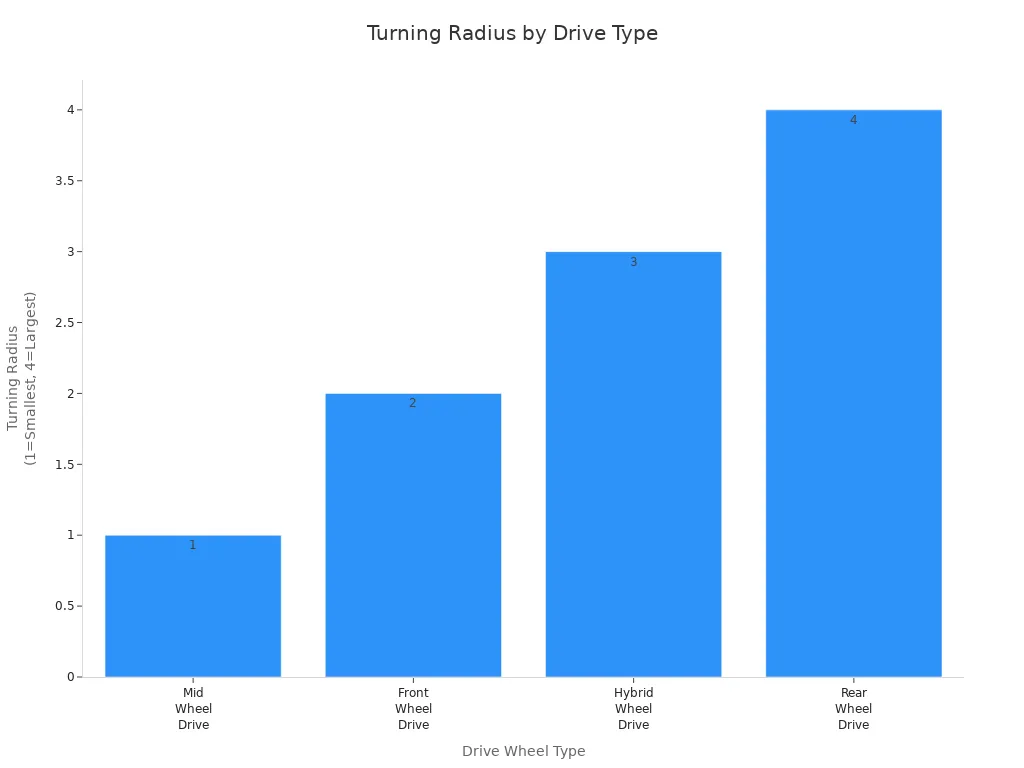
Note: Your comfort and safety depend on both your position and the drive type. Try different models to see which feels best for your daily life.
When you pick a power wheelchair or scooter, think about where you will use it most. If you need to turn in small spaces, a mid-wheel drive with your weight centered over the drive wheels may work best. If you want more stability outdoors or at higher speeds, rear-wheel drive could be a better fit. Your position on the device shapes how you move, turn, and feel every day.
Scooter and Wheelchair Types
Power Wheelchairs
Power wheelchairs are great for moving in small spaces. They use electric motors to help you move around. Many have mid-wheel drive, so the drive wheels sit under your seat. This lets you spin almost in one spot. Some electric wheelchairs have a . That means you can turn without moving forward or backward. This is helpful in small rooms, busy halls, or elevators.
Electric wheelchairs work best indoors because they turn tightly. You can move around furniture and go through doors easily. Getting into elevators is simple too. Some models can handle outdoor ground, but their main strength is moving in tight spots. If you need to turn fast or change direction, electric wheelchairs help you do that.
Power wheelchairs need less space to turn than mobility scooters. Their turning radius is much smaller. Most scooters need about all the way. This is because many electric wheelchairs use a mid-wheel drive system.
Scooter Types
There are different scooters for different needs. Travel scooters are light and easy to take apart. You can put them in a car or store them at home. Heavy-duty scooters hold more weight and work on rough ground. These are good for outside. Folding scooters can fold up for storage or travel.
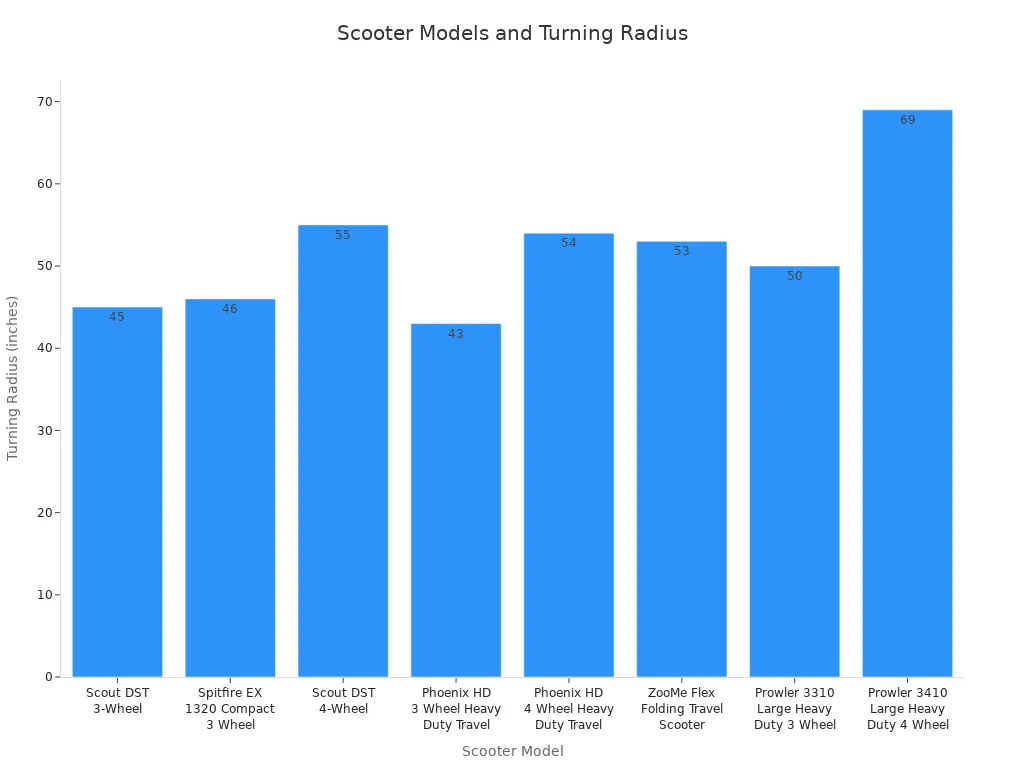
for some scooter types and models:
| Scooter Type and Model | Turning Radius (inches) |
|---|---|
| Travel Scooters: | |
| – Scout DST 3-Wheel | 45 |
| – Spitfire EX 1320 Compact 3 Wheel | 46 |
| – Scout DST 4-Wheel | 55 |
| – Phoenix HD 3 Wheel Heavy Duty Travel | 43 |
| – Phoenix HD 4 Wheel Heavy Duty Travel | 54 |
| Folding Scooter: | |
| – ZooMe Flex Folding Travel Scooter | 53 |
| Heavy-Duty Scooters: | |
| – Prowler 3310 Large Heavy Duty 3 Wheel | 50 |
| – Prowler 3410 Large Heavy Duty 4 Wheel | 69 |
Travel and folding scooters turn in smaller spaces than heavy-duty ones. This makes them easier to use inside or in crowds. Heavy-duty scooters are steadier on rough ground, but they need more room to turn.
3-Wheel vs 4-Wheel
Three-wheel and four-wheel scooters are different in how they move and feel. Three-wheel scooters can than four-wheel scooters. This makes them .
3-wheel scooters turn well and fit in tight spots.
You can move around things and go through narrow places.
They are lighter and easier to carry because they have one less wheel.
3-wheel scooters are best for indoors or places where you need sharp turns.
Four-wheel scooters are more stable, especially on bumpy ground. They have a bigger turning radius, so they are not as quick in small spaces. The extra wheel gives you a smoother ride, but turning in small rooms is harder.
4-wheel scooters are steadier on rough ground.
They are not as good for tight turns or crowded rooms.
The heavier build makes them harder to turn in small spaces.
Tip: If you are indoors or in crowds a lot, a 3-wheel scooter may be best. If you need more steadiness outside, a 4-wheel scooter gives a smoother ride.
Mid-Wheel vs Rear-Wheel
When you choose a or power wheelchair, you often see two main drive types: mid-wheel and rear-wheel. Each type changes how you move and turn in daily life. Understanding these differences helps you pick the best scooter for your needs.
Mid-wheel drive scooters place the main wheels right under your seat. This design lines up the drive wheels with your center of gravity. You get the with this setup. You can spin your mobility scooter almost in place. This makes it easy to move through narrow hallways, doorways, or crowded rooms. If you use your scooter indoors, you will notice how simple it is to turn around furniture or fit into elevators. Research shows that mid-wheel drive wheelchairs than rear-wheel models. You can make a in a much smaller area.
Rear-wheel drive scooters put the drive wheels behind your seat. This setup gives you more stability when you ride outdoors or go over rough ground. You feel steady at higher speeds or on uneven paths. However, the turning radius is much larger. You need more space to turn your mobility scooter around. This can make it harder to move in small rooms or tight corners. Rear-wheel drive scooters work best if you spend most of your time outside or need extra support on bumpy surfaces.
Here is a quick comparison to help you see the main differences:
| Feature | Mid-Wheel Drive Scooter | Rear-Wheel Drive Scooter |
|---|---|---|
| Turning Radius | Smallest, turns in place | Larger, needs more space |
| Indoor Maneuverability | Excellent, fits tight spaces | Limited, harder in small rooms |
| Outdoor Stability | Good, but less than rear-wheel | Best, handles rough terrain |
| Learning Curve | Easy to control indoors | Feels stable at speed |
Tip: If you use your mobility scooter mostly indoors or in places with lots of obstacles, a mid-wheel drive scooter gives you the best maneuverability. For outdoor use or longer rides, a rear-wheel drive scooter offers more stability.
Many modern scooters, like the SanLi Care Model S300, use advanced wheel designs to combine the best of both worlds. Some scooters feature omni-wheels, which allow for even tighter turns and smoother movement in all directions. These features help you enjoy both indoor and outdoor activities without giving up comfort or control.
When you test a mobility scooter, try turning in a small space. Notice how much room you need to make a full turn. This simple test shows you how the drive type affects your daily movement. Picking the right scooter drive type can make your life easier and help you stay independent.
Tighter Turning Radius Benefits
Indoor Navigation
Moving around at home or in buildings can be hard. A tighter turning radius helps you get around furniture and corners easily. You do not need to back up or turn many times. This makes your day easier and less stressful.
Scooters with big turning radii, like full-size and 4-wheel ones, have trouble in small spaces.
, so you can avoid things and fit through narrow doors.
3-wheel scooters are best for indoors because they turn better, even though 4-wheel scooters are almost as stable.
Many people find it tough to make big turns or move in crowded aisles. A tighter turning radius fixes these problems and makes you more comfortable.
When your device turns sharply, moving in tight spaces is much easier. This helps you stay independent and feel sure of yourself at home.
Public Spaces
You go to places like malls, restaurants, or offices. These places can have crowded halls, small aisles, or busy elevators. If your device has a small turning radius, you can move through these spaces easily. You do not have to worry about bumping into people or getting stuck.
A device that turns well lets you:
Turn fast in crowded rooms.
Get in and out of elevators easily.
Move around tables and store displays.
Feel better in busy places.
You can enjoy indoor and outdoor activities when your device handles tight spaces. This makes going out and running errands much easier.
Accessibility
Accessibility means you can use places and services without problems. The turning radius of your device is important for this. Rules like ANSI A117.1-2017 now say spaces must have a . This helps you turn safely and on your own, even in small spaces.
. Builders must make ramps wide enough and give you space to turn. This makes moving safer and easier, especially when you need to change direction.
You use these rules every day. You can enter buildings, use restrooms, and move in public places with less worry. A device with a tighter turning radius gives you more choices and helps you move better.
Tip: Pick a that fits your daily life and the places you go most. A tighter turning radius is best for indoors and helps you in tight spaces everywhere.
Choosing the Right Scooter
Assessing Needs
You should start by thinking about your daily life and what you need from a mobility device. Every person has different needs, so it helps to look at several factors before you choose.
. Indoor spaces like homes and offices need a tight turning radius. Outdoor areas may need bigger wheels and a strong frame.
Consider how far and how often you travel. If you use your device for long trips, you need a good battery and reliable power.
Check if you need extra support, such as backrests, headrests, or special cushions. These features help prevent discomfort and keep you safe.
Look for adjustable seats, armrests, and footrests. These options help you stay comfortable and keep good posture.
Decide if you need a device that moves quickly or one that turns easily. Indoor use often needs slower speeds and better maneuverability.
Make sure the device fits your weight and has the right safety features.
Review the places you visit. Some buildings have small elevators or narrow doors. The Americans with Disabilities Act (ADA) says you need at least 67 inches of space to turn safely.
Tip: Match the turning radius of your scooter or wheelchair to your daily spaces and activities. This helps you stay independent and comfortable.
Comparing Models
When you compare different models, focus on how each one turns and moves. Turning radius is a key part of maneuverability, but you should also look at other features that make your life easier.
Here is a table showing how certain features help with turning and movement:
| Feature | How It Helps You Move and Turn |
|---|---|
| Omni-wheels | Let you glide in any direction. You can turn sharply and move through tight spots. Some models, like the SanLi Care Model S300, use omni-wheels to achieve a turning radius as tight as 79 cm (about 31 inches). |
| Foldability | Makes it easy to store or carry your device. You can fold it up for travel or to fit in small spaces. This does not change the turning radius, but it helps with overall mobility. |
| Smart Technology | Lets you control your scooter with a phone app. You can adjust speed, check battery life, and even lock or unlock your device. This makes it easier to move and turn in different places. |
The stands out as a great example. It combines three devices in one: an electric wheelchair, a smart scooter, and an e-push assist chair. The S300 uses patented front omni-wheels, giving you a tight 79 cm turning radius. You can turn easily in elevators, apartments, and offices. The lightweight, foldable frame lets you store or transport it with little effort. Smart features like Bluetooth control and a mobile app help you adjust settings and check your device from anywhere.
When you look at other models, check their turning radius. Many power wheelchairs have a turning radius of 20 to 30 inches. Most scooters need more space, often 40 to 55 inches. The S300’s 79 cm (31 inches) turning radius is among the best for a scooter, making it ideal for tight indoor spaces.
Note: Always compare the turning radius and extra features. A device with omni-wheels and smart controls can make daily movement much easier.
Test Drives
You should always try out different scooters and wheelchairs before you buy one. helps you feel how each device moves and turns.
You can see how each model handles tight corners and small rooms.
You will notice the difference in maneuverability between scooters and power wheelchairs.
Trying several models helps you find the one that matches your lifestyle and mobility needs.
You can check which device feels most comfortable and easy to use.
Test drives help you pick a device that you can control with confidence.
Tip: Bring a list of your daily routes and try them during your test drive. This helps you see if the device fits your real-life needs.
Features for Better Maneuverability
Adjustable Settings
You can make your move better by changing some settings. These let you raise or lower the seat, change the back support, and move the foot platform. When you adjust these, you feel more comfortable and can control your device better. Some devices, like the SanLi Care Model S300, let you change the seat height and back angle. This helps you find the best spot for your body. It makes steering and turning easier.
The . Here is a table that shows how each drive type affects turning radius and movement:
| Drive Type | Turning Radius & Maneuverability Impact | Additional Notes |
|---|---|---|
| Front-Wheel Drive | Larger turning radius, less suitable for tight spaces | Better for outdoor terrain and obstacle climbing |
| Mid-Wheel Drive | Tightest turning radius, best for tight spaces | Ideal for indoor use, smooth turning |
| Rear-Wheel Drive | Larger turning radius, less maneuverable indoors | Good for straight-line stability and speed |
. A sensitive joystick lets you turn quickly and make small moves. Suspension and tire types help your device handle bumps and corners better. All these settings work together to give you more control and comfort.
Smart Technology
Smart technology makes using your mobility device easier. Devices like the S300 have Bluetooth and a mobile app. You can use your phone to steer, lock, or unlock your scooter. This lets you control your device from far away.
. They use sensors to avoid things and change to different ground. Some smart wheelchairs can learn how you drive and change how they react. Voice or gesture controls help if you have trouble using your hands.
Smart technology lets you move with less work and more confidence. You can focus on where you want to go. The device helps you avoid bumps and tight spots.
Safety Features
Safety features keep you safe while you move and turn. The S300 has incline detection and overspeed braking. These slow you down on hills and stop slips. Electromagnetic brakes and explosion-proof wheels help you stop or turn safely.
You should always sit up straight and keep your feet on the footrests. This stops you from tipping over in sharp turns. Devices with good brakes and stability help you control your device in small spaces. Lights and horns help others see you in crowds.
.
Use devices made for easy indoor movement.
Pick ergonomic designs that support your body.
When you choose a device with strong safety features, you can move without worry. You stay in control, even in busy or narrow places.
Tips for Users
Practice Techniques
You can get better at using your device by practicing often. Experts say you should set goals for your training. Use to help you stay on track. Try moving through small spaces and around things in your way. Practice going up and down ramps and curbs. Work on your strength with arm exercises and easy cardio. This helps you use your device longer. Practice getting in and out of your chair or scooter. This makes you feel more sure in daily life. Use smart wheelchairs or helpful gadgets to make moving easier. Ask therapists or trainers for advice. Good feedback helps you learn new skills faster.
Experts say you should start learning before you get your device. Keep practicing after you have it. Some clinics use to help you practice safely. to see what fits you best. A professional can help you pick the right wheels, seat, and suspension for your needs.
Maintenance
Taking care of your device keeps it working well. Good care helps you turn better and move smoothly. for damage or wear. Clean your device often to stop dirt from building up. Try not to use it in bad weather or on rough ground if you can.
| Maintenance Task | Why It Matters |
|---|---|
| Check brakes and wheels | Keeps turning radius tight and movement smooth |
| Clean frame and parts | Prevents dirt buildup that can slow you down |
| Inspect for damage | Stops small problems from getting worse |
If you use your device on gravel or grass, check the wheels more often. and keep moving well. Taking care of your device also keeps you safe outside or on bumpy ground.
Accessories
The right accessories make your device easier and more comfortable to use. Some help you turn better and control your device more easily.
let you move the joystick for comfort. This helps you not bump into things and gives you more room for your legs.
Swing away leg rests let you move your feet for comfort and better control. These are good for long trips or outdoor use.
Heel loops keep your feet in place on the footrests. This helps you stay in control on rough ground.
make steering easier if your hands hurt or feel weak.
Power seat lifts raise your seat so you can reach things and see better.
| Accessory Name | How It Helps You Move and Turn |
|---|---|
| Swing Away Joystick | Adjusts for comfort and control, helps avoid obstacles |
| Swing Away Leg Rests | Offers flexible foot positioning, supports better maneuverability |
| Heel Loops | Keeps feet stable, aids in control on different terrain |
| Power Wheelchair Joystick Ball Knob | Makes steering easier for users with weak hands |
| Power Seat Lift | Raises seat for better access and control |
Tip: Try out different accessories to see which ones help you most. The right setup can make moving easier and help you every day.
A tight turning radius makes moving around much easier. You can turn in small rooms and go through doors. It also helps you avoid things in your way. Here are some important things to remember:
A at home or work.
Shorter wheelchairs are easier to turn, so they work well indoors.
Picking the right size and turning radius gives you more comfort and lets you do more on your own.
| Device Type | Turning Radius & Maneuverability | Notes |
|---|---|---|
| Power Wheelchair | Tight turning radius; best for small spaces | Needs joystick skill; stable |
| Mobility Scooter | Larger turning radius; less maneuverable indoors | Good for outdoor or longer distances |
Try out different models and check the size of your rooms. Talk to an expert to help you choose what works best for you.
FAQ
What is a good turning radius for indoor use?
A under 32 inches works well for most homes and offices. You can move around furniture and through doorways more easily with a smaller turning radius.
How do omni-wheels help with maneuverability?
Omni-wheels let you move in any direction without turning the whole device. You can spin, slide sideways, or make sharp turns. This makes tight spaces much easier to handle.
Can I control my scooter with my phone?
Yes! Some scooters, like the , use Bluetooth and a mobile app. You can steer, lock, or check your scooter’s battery right from your smartphone.
Why does drive type affect turning radius?
Drive type changes where the main wheels sit. Mid-wheel drive lets you turn in place. Rear-wheel drive needs more space to turn. You should pick the drive type that fits your daily spaces.
Is a tighter turning radius always better?
A tighter turning radius helps indoors. For outdoor use, you may want more stability. You should balance turning ability with comfort and safety for your needs.
How do I test a scooter’s turning radius?
You can try turning in a small room or around obstacles. See how much space you need to make a full circle. Always test the scooter in places like your home or office.
What safety features help with sharp turns?
Look for features like electromagnetic brakes, incline detection, and anti-tip wheels. These keep you safe when you turn quickly or move on slopes.
Does foldability affect turning radius?