
after using mobility scooters.
| Study | Population | Increased Independence (%) |
|---|---|---|
| Sammuelsson & Wressle (2014) | Mobility scooter users (80% elderly) | 80% |
| Barton et al. (2014) | All ages | 74% |
Today, there are more elderly electric scooter models to pick from. These scooters are smart, easy to carry, and simple to use.
. This happens because of new technology, better batteries, and more people wanting comfort and safety as they age. You can feel sure that these devices help you or your loved ones stay active and independent.
Key Takeaways
let elderly people move by themselves. This helps them feel more confident and free. These scooters make it easier to see family and friends. They also help people go to events in the community. Picking the right scooter depends on what you need. You should also think about your home and where you will use it. Safety features like brakes, seat belts, and lights are very important. They help stop accidents and keep people safe. There are different types of scooters for different needs. Some have 3 wheels, some have 4, some are heavy-duty, and some can fold. Comfort and easy turning are important too. Look for seats you can adjust and scooters that turn in small spaces. Take care of your scooter and learn how to use it safely. This will help it last longer and work well. Insurance and planning your budget can help you pay for a scooter. Make sure to check what your insurance covers and how much it costs before you buy.
Benefits
Mobility
Using a mobility scooter gives you . Many older people say these devices help them do things by themselves. You can move around your house or go to the park alone. You can also shop at the mall without needing help. This makes you feel more confident and lets you enjoy life.
You can go to parks, malls, and other places easily.
The scooter moves for you, so you do not get tired.
You and can .
You feel happier and less worried because you can stay active.
A mobility scooter helps you do more outside. You do not have to worry about not being able to move well. These scooters are comfortable, safe, and easy to use. That is why many older people like them.
“A mobility scooter gives you back your freedom. You can go anywhere, anytime, without waiting for someone to help.”
Social Life
It is easier to stay close to family and friends when you can move around. Power wheelchair scooters help you go to and visit friends. You can on events in your community. You can do things with others that you could not do before.
Studies show that powered scooters help older people do more and join in. These scooters help you make better connections with family and friends. You feel less alone and more included.
| Benefit | Explanation |
|---|---|
| Independence | You can move by yourself and do more things alone. |
| Mental Health | You feel less lonely and more sure of yourself, which helps your mood. |
| Social Engagement | You go to events and see people, making stronger friendships. |
A motorized scooter helps you get out and see the world. You can go to parks, events, and stores by yourself. This freedom helps you feel less sad and more happy.
Convenience
A mobility scooter makes daily life much easier. The controls are simple, so you can use it even if moving is hard. Many scooters have soft seats and armrests, so you stay comfy on long rides.
Some scooters are light and .
Safety parts like anti-tip wheels and speed controls keep you safe.
The battery lasts a long time, so you can go farther.
You can pick from 3-wheel or 4-wheel scooters to fit your needs.
Many older people think scooters are . They are great for going outside or taking short trips. Scooters look less like medical equipment, so you may feel better using them in public. You can or store it. This makes it a good choice for many people.
Tip: to see which one works best for you.
Safety
Safety is very important when you pick a power wheelchair scooter. As people get older, their senses and reflexes slow down. This makes accidents more likely when using a mobility device. Studies show older users have a higher chance of getting hurt badly from falls or traffic accidents. It is important to know about these risks so you can stay safe and feel sure of yourself.
| Aspect | Statistic / Finding |
|---|---|
| Increased risk for elderly (≥70 years) of severe injury | Odds Ratio (OR) 2.124 (95% CI: 1.239–3.642) |
| Proportion of elderly in severe injury group | 59.6% vs. 43.0% in mild/moderate group (P=0.003) |
| Common injury types in severe group | Head injuries (80.7% vs. 38.6%), Torso injuries (32.1% vs. 16.8%) |
| Injury circumstances more frequent in severe group | Traffic accidents and falls (P=0.042), daytime injuries (82.4% vs. 72.6%) |
| Hospital outcomes for severe group | Hospital admission (82.6% vs. 28.5%), ICU admission (37.6% vs. 1.7%), Death after admission (10.3% vs. 1.4%), Total mortality (9.2% vs. 0.7%) |
| Trends in traffic accidents | Increased from 10.5% (2011) to 35.0% (2018) of all injuries |
| Common fall locations | Stairs (29.1%), farm roads (25.5%) |
| Protective device usage | >70% of users do not wear seat belts; helmets and seat belts recommended but not widely used |
| Environmental risk factors | Uneven sidewalks, users driving on roads leading to collisions with vehicles |
| Age-related risk factors | Decline in sensory, cognitive, motor functions increases accident risk and injury severity |
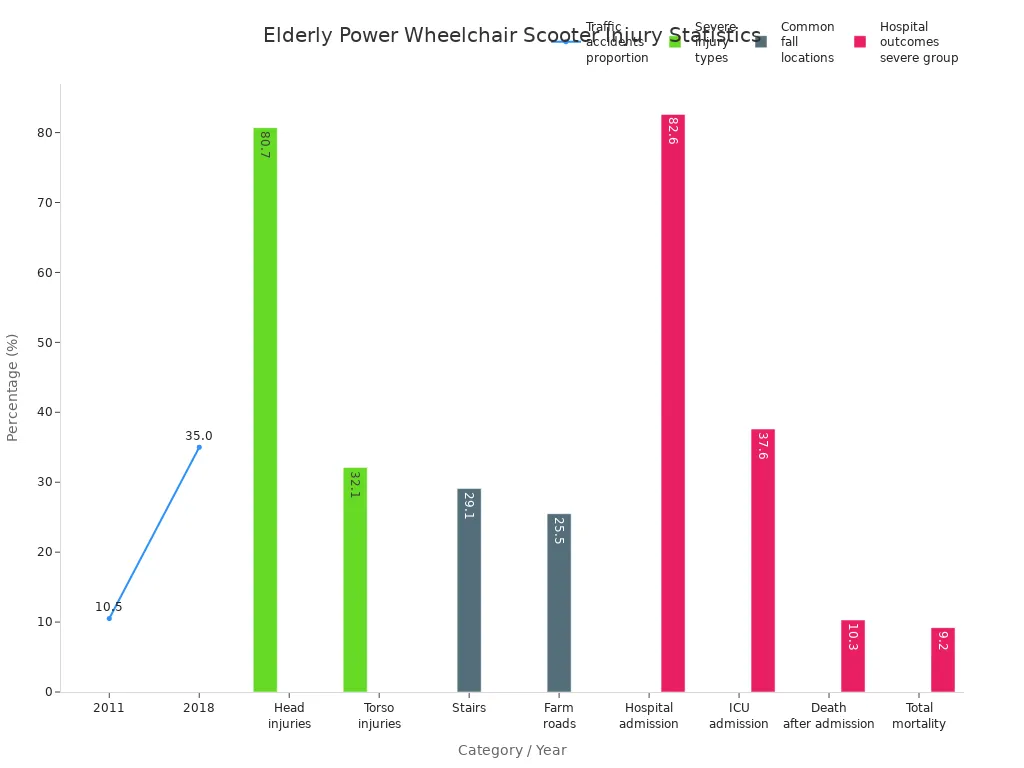
You can be safer by picking a scooter with good safety features. Many new scooters have:
to help you stay steady on hills or bumpy ground
Seat belts or harnesses to keep you in your seat
Lights and reflectors so others can see you at night
A scooter with these features helps you feel safe everywhere. Always wear your seat belt and check the lights before you go out. Try not to drive on busy roads or rough sidewalks. When you use your scooter in public, watch out for cars and things in your way.
Tip: Check your scooter for loose parts or worn tires often. A quick look before you ride can stop accidents and keep you safe.
Safety technology is getting better every year. Some scooters now have smart alerts, brakes that work by themselves, and apps to help you watch your scooter. These tools help you feel calm and let you stay independent while you do your daily things.
Power Wheelchair Scooter Types
3-Wheel
A 3-wheel electric scooter is good for small spaces. It has one wheel in front, so it turns easily. You can move around corners in tight rooms or stores. The design gives you more space for your legs. This makes the ride feel better.
3-wheel scooters are light and small.
You can put them in a car or store them easily.
They work best inside or on flat ground.
The SanLi Care Model S300 is a 3-in-1 power wheelchair scooter. You can use it as an electric wheelchair, smart scooter, or e-push assist chair. Its special omni-wheels help you turn in narrow halls. You can use a mobile app to control it and check the battery. It has safety features to keep you safe. This scooter helps you stay independent and sure of yourself.
Tip: Pick a 3-wheel scooter if you want to at home or in public places.
4-Wheel
A 4-wheel elderly electric scooter gives you more balance. It has two wheels in front and two in back. The ride feels smoother, even outside or on bumpy ground. Four wheels help you stay steady and not tip over.
| Feature | 3-Wheel Scooters | 4-Wheel Scooters |
|---|---|---|
| Maneuverability | Turns tighter, great for small spaces | Turns wider, not as quick indoors |
| Stability | Less steady, best for smooth floors | More steady, good for rough ground |
| Portability | Lighter and easy to move | Heavier and stronger build |
You may like 4-wheel scooters if you go outside a lot. They work well on gravel, grass, or ramps. These scooters handle bumps and hills better than 3-wheel ones. They can also carry more weight, so more people can use them.
Note: 4-wheel scooters do not turn as well in small spaces but are great outside and on rough ground.
Heavy-Duty
Heavy duty electric scooters are strong and last a long time. They are good if you . These scooters have tough frames, strong motors, and big wheels. You can use them every day at home or outside.
Heavy duty scooters hold more weight and give a steady ride.
You need enough strength and balance to use the controls.
Your home should have enough space and smooth floors for easy use.
These scooters help you do daily things, like moving from room to room or going out.
These scooters are helpful if you want to stay active and do things by yourself at home. They are best for people who need strong support and plan to use the scooter mostly inside.
Tip: Always check the weight limit and size before picking a heavy-duty scooter to make sure it fits you.
Foldable
Foldable power wheelchair scooters are very easy to use. They are great for people who want to move their scooter a lot. You can , usually in just a few steps. You do not need any special tools to do this. This makes them perfect if you travel a lot or have little space at home.
If you pick a foldable scooter, you can take it almost anywhere. Most foldable scooters . You can lift them into a car trunk or put them in a closet. Their small size lets them fit in apartments, offices, or under a desk. If you like to visit friends, shop, or see new places, a foldable scooter helps you stay busy.
Tip: Many airlines and buses let you bring foldable scooters. This makes trips easier and more fun.
Foldable scooters are special because they can change to fit your needs. Some fold up by pressing a button. Others fold by hand in a simple way. Some scooters can come apart into smaller pieces. This makes it easier to lift and move them. You can handle your scooter by yourself without needing help.
:
| Feature | Foldable Power Wheelchair Scooters | Non-Foldable Power Wheelchair Scooters |
|---|---|---|
| Portability | Very easy to carry and fold; simple to move | Bigger and heavier; hard to move and store |
| Storage | Fits in closets, car trunks, and small places | Needs more room because it does not fold |
| Weight | Usually lighter | Heavier |
| Ease of Use | Easy to turn in small spaces; quick to set up | More steady but harder to turn in tight spots |
| Comfort | Not as comfy for long rides | More comfy for long rides |
| Weight Capacity | Holds less weight | Holds more weight |
| Terrain Capability | Not good on rough ground | Works better on rough ground |
| Maintenance | May need more care because of folding parts | Needs less care; parts are stronger |
Foldable scooters work best in cities and for short trips. They are light and turn easily in busy stores or small halls. If you need to put your scooter in a car or , a foldable one saves time and effort.
But, foldable scooters may have smaller wheels and hold less weight than non-foldable ones. They are best for smooth floors and for people who do not need to go far on rough ground. For shopping, seeing friends, or travel, a foldable power wheelchair scooter lets you go where you want, when you want.
Note: Always check how the scooter folds before you buy it. Some people like folding by hand because it is simple. Others like the easy push-button folding.
Foldable scooters help you stay active and do things on your own. Their design lets you move around at home, with friends, or even when you travel far away.
Features
Maneuverability
It is important for your scooter to move well in small spaces. This is very helpful if you live in an apartment or go to busy stores. It also helps when you use elevators. Most top scooters can turn in a circle that is wide. The WHILL Model C2 can turn in just 20 inches. If the turning circle is smaller, you can get through doors and around furniture more easily. You can turn corners in tight halls or crowded rooms without much trouble.
The SanLi Care Model S300 has special front omni-wheels. These wheels let you turn in a tight 79cm space. You can move through small areas and make sharp turns easily. This helps you stay independent at home and when you go out.
Tip: Always look at the turning circle before you pick a scooter. A smaller turning circle means it is easier to use inside.
Comfort
Comfort is important if you want to use your scooter every day. New scooters have special features to help your body feel good and not get tired. You will see:
that is soft and easy to use
Handles and controls that are shaped for your hands
and that have soft padding
Cushions with and support for your back
Cup holders that turn and mirrors to help you see behind you
You can change the seat height and back angle on the SanLi Care Model S300. The seat has soft padding to stop pressure sores. The controls feel easy to hold, so steering is simple. These things help you stay comfy on long trips and stop pain.
Note: Try to find scooters with parts you can adjust. Armrests and headrests that move help you fit the scooter to your body.
Safety Tech
Safety tech keeps you safe when you ride your scooter. Today’s scooters use smart tools to protect you in many ways. :
| Category | Advanced Safety Technologies |
|---|---|
| Advanced Driver Assistance | Collision avoidance sensors, Automatic lighting adjustment, Terrain detection algorithms |
| Health Integration Features | Fall detection with alarm alerts, Vital sign monitoring, Medical reminder systems |
| Connectivity Solutions | GPS tracking, Remote diagnostics, Geofencing capabilities |
| User-Specific Safety | High-contrast displays, Auditory signal adjustments, Haptic feedback systems |
The SanLi Care Model S300 has incline detection and brakes that slow you down if you go too fast. These features help you stay safe on hills and slopes. You can use a phone app to lock your scooter and check the battery. You can also add GPS and video calls for more safety, which is good if you travel alone.
Always wear your seat belt and check your lights before you leave. Smart safety tech helps you feel safe every time you use your scooter.
Portability
You want a power wheelchair scooter that matches your life. Portability is important if you travel or need to store your scooter. Many new scooters fold up or come apart. This makes them easy to carry and put away. Light frames help you lift the scooter into a car or closet.
| Model Name | Weight (with battery) | Weight Capacity (lbs) | Folding/Portability Features |
|---|---|---|---|
| Journey So Lite Folding Scooter | 44.5 lbs | 275 | Combines 4-wheel stability with 3-wheel convenience |
| SmartScoot Foldable Scooter | 40 lbs | 250 | Breaks down into 3 pieces, stainless steel frame |
| EV Rider TeQno Auto Folding | 73 lbs (65 lbs no batt) | 250 | Automatic folding/unfolding with button |
| Golden Buzzaround CarryOn | 65 lbs | 300 | Disassembles into 2 pieces for compact storage |
| iLiving V8 Foldable Scooter | 40 lbs | 275 | Lightweight aircraft-grade aluminum frame |
| Vive Health 4-Wheel Scooter | 88.2 lbs | 265 | Disassembles into 4 pieces, swivel seat |
| Metro Mobility Air Classic | 41 lbs | 265 | Compact, good driving range |
| ComfyGo Z-4 Ultra-Light Scooter | Heaviest piece 30 lbs | 350 | Quick-detach frame, fits in small trunks |
| Enhance Mobility Solax Transformer | 55 lbs | 300 | Airline approved, suspension system |
| Feather 27X | 27-30 lbs | 250 | One of the lightest, airline approved |

Lighter scooters are easier to move and store. Many can fold up fast or break into smaller parts. This helps you take your scooter on planes, buses, or in cars.
The SanLi Care Model S300 is very easy to move. You can fold it in four quick steps. Its light aluminum frame is easy to lift. The folded scooter fits in trunks, closets, or small spaces at home. The S300 is also , so you can bring it on trips.
Tip: Always look at the folded size and weight before you pick a scooter. Make sure you can lift and store it by yourself.
If you travel a lot or have little space, a portable scooter like the S300 gives you more freedom. You can go anywhere without worrying about heavy gear.
Smart Controls
Smart controls make your scooter simple and safe to use. Many new scooters have cool technology that puts you in charge. You can drive with a joystick, a remote, or even a phone app. Some scooters let you use Bluetooth for easy steering.
Joystick or remote for easy turning
Bluetooth for hands-free use
Phone app control on some scooters
Voice commands in certain models
GPS tracking for safety
Health checks through apps
Change speed and how the scooter moves
Save your favorite settings
Extra safety features with smart controls
The SanLi Care Model S300 has many smart controls. You can connect your phone with Bluetooth and use the app. The app lets you lock or unlock the scooter, check the battery, and track where it is. You can even move the scooter without sitting on it. You can add GPS and video calls for more safety and help.
Note: Smart controls help you stay independent. You can change settings, check your scooter, and keep it safe—all from your phone.
With these smart tools, you get more than just a way to move. You feel safer and more sure of yourself. Pick a scooter with smart controls to make every ride easier and more fun.
Choosing a Power Wheelchair Scooter
Needs
Selecting the right power wheelchair scooter starts with understanding your unique needs. You want a device that matches your daily life and supports your independence. Begin by thinking about your . If you have stumbled or fallen before, you may need extra stability. Consider how much help you need with daily activities like dressing, bathing, or cooking. If you find these tasks hard, a scooter can make them easier.
Ask yourself these questions:
Have you had trouble walking or using other mobility aids?
Do you need help with personal care or moving around your home?
Is your home easy to move through with a scooter, or are there stairs and tight spaces?
Can you use your arms and legs well enough to control a scooter?
Will a scooter help you do more on your own each day?
Has your doctor said you need a power wheelchair or scooter for medical reasons?
What type of scooter fits your lifestyle—do you need something for indoors, outdoors, or both?
You may also want to look at different types of scooters. Some work best indoors, while others handle rough ground outside. For example, have strong wheels and suspension for bumpy paths. Always match the scooter type to your needs and where you plan to use it.
Tip: Write down your daily routine and list the places you want to visit. This helps you see what features matter most.
Environment
Your home and travel environment play a big role in choosing a scooter. If you live in a small apartment, you need a scooter that turns easily and fits through doorways. work well in tight spaces. These scooters are easy to store and carry.
If you plan to use your scooter outside, think about the ground and distance. Some scooters are small and light, perfect for short trips and smooth sidewalks. Others are bigger and built for longer rides or rougher ground. These have features like headlights, mirrors, and strong tires.
Consider these points:
fit well indoors and in cars.
Larger scooters handle outdoor trips and rough paths better.
Urban areas may have crowded sidewalks and few parking spots.
You may need to plan your route to avoid obstacles.
Look for places to park and charge your scooter near your home or favorite spots.
A table can help you compare:
| Environment Type | Best Scooter Features |
|---|---|
| Small Home/Apartment | Tight turning radius, lightweight, foldable |
| Outdoor/Long Trips | Large wheels, strong battery, safety lights |
| Urban Areas | Compact size, easy storage, good maneuverability |
Note: Always check your home’s doorways and hallways before buying. Measure to make sure your scooter will fit.
Fit
A good fit keeps you comfortable and safe. You need a scooter that matches your body size and shape. Start by measuring your hips, shoulders, and chest. The seat should be wide enough for your hips but not too wide. This helps prevent pressure sores.
Check the seat depth. You want about two inches between the seat edge and the back of your knees. This keeps blood flowing and stops discomfort. The backrest should support your shoulders and back. Some people need a full-length backrest, while others need extra support for medical reasons.
Armrests and footrests matter too. The armrests should let your arms rest at a 90-degree angle. The footrest should keep your legs level and prevent your pelvis from tilting. If you need to recline, look for calf support.
Here is a checklist for a proper fit:
matches your hips
Seat depth leaves space behind your knees
Backrest supports your shoulders and back
Armrests are at the right height and length
Footrest fits your leg length and style
Weight capacity supports your body safely
Always try out the scooter before you buy. Adjust the seat, armrests, and footrests to see if you feel comfortable.
A well-fitted scooter helps you stay active and prevents pain or injury. Take time to measure and adjust everything for the best experience.
Budget
You should think about your budget before buying a power wheelchair scooter. Prices are very different for each scooter. The price depends on what features, brand, and type you pick. Some scooters are simple, but others have more technology and comfort.
:
| Price Tier | Price Range | Characteristics and Examples |
|---|---|---|
| Low-End | Starting at $699 | Basic features, heavier, fewer comfort options |
| Medium-Price | $1,699 – $1,950 | More features, lighter, durable |
| High-End | Starting at $1,995 | Ultra-lightweight, durable materials, digital controls |
| Folding Mobility Scooters | $899 – $3,899 | Portable, compact design, suitable for indoor/outdoor use |
. If Medicare helps pay, those scooters usually cost $600 to $1,300. The price changes if you want a bigger scooter, a special brand, or extra parts. Folding scooters cost between $899 and $3,899.
Here are some popular models and their prices:
Enhance Mobility Solax Transformer 2: $2,775
Feather 27X Lightweight Folding Scooter: $2,895
Vive Health 4-Wheel Scooter: $799
Transformer Remote-Controlled Folding Scooter: $2,425
When you plan your budget, think about what features you need most. A basic scooter costs less but may not be as comfy or smart. High-end scooters are lighter, have more comfort, and smart controls. These things can make your life easier and safer.
Tip: Write down the features you really want. Look at prices and see which scooters fit your needs and your budget.
Remember to think about extra costs too. You might need to buy accessories, pay for repairs, or get new batteries. Some insurance or government programs can help pay, but they often only cover basic scooters.
If you travel a lot or want a , you may need to spend more. Buying a good scooter can save you money later because it breaks less and works better.
Insurance
Insurance can help pay for your power wheelchair scooter. Medicare, Medicaid, and private insurance might pay some or all of the cost if you follow their rules.
Medicare Part B pays for power wheelchairs and scooters as medical equipment. You must meet certain steps to get help:
You need to see a doctor for a mobility check.
Your doctor must write down that moving is hard for you.
You must show that other aids, like canes or regular wheelchairs, do not help enough.
Your doctor must say you can use the scooter safely.
Your home must be good for using a scooter.
Your doctor must give you a prescription for the scooter.
After you do these steps, after your Part B deductible. The supplier usually asks for approval first. You should use a supplier who works with Medicare to keep your costs low.
Medicare Advantage plans cover at least what Original Medicare does. These plans may have different steps or need more forms. Medicaid rules change by state and may need more papers from your doctor or therapist.
Key things to remember:
.
Your doctor must show you need the scooter for your home.
The supplier sends in the forms for approval before you get your scooter.
Medicaid and private insurance have their own rules and may pay more or less than Medicare.
Note: Always ask your insurance company before you buy a scooter. Find out what papers you need and which scooters they will pay for.
If you have questions, talk to your doctor or a mobility expert. They can help you learn your choices and guide you through the steps. This way, you can get the scooter you need without too much trouble or cost.
Elderly Electric Scooter Use
Learning
When you learn to use an elderly electric scooter, you feel safer and more sure of yourself. Start by learning simple things like turning, stopping, and using the controls. Many . These lessons show you how to go around things, miss bumps, and turn in small spaces. You also learn how to go up and down ramps and curbs.
. You get to practice in real life and on a screen. You learn what to do on busy sidewalks and in crowded rooms. Community classes and special tools help you get better and do more on your own. Practicing these skills makes you feel good about using your scooter every day.
Tip: Ask your doctor or nurse about classes or programs in your area for elderly electric scooter users.
Maintenance
Doing regular care keeps your electric scooter working well and safe. You should have a plan to stop problems and help your scooter last longer.
. Charge the battery all the way and do it often.
Look at the tires to see if they are full and not worn out. Put oil on the wheels and axles with silicone spray.
Keep your scooter inside, away from water and sunlight.
Check the frame and seat for cracks or loose parts. Tighten any bolts or screws that are loose.
Listen for strange sounds. Fix any problems right away.
Test the motor, brakes, and steering often.
Have a pro check your scooter at least once a year.
You should also wipe down your scooter every week and look it over closely each month. . Always turn it off when you get on or off. Be careful on bumpy or rough ground to stay safe.
Note: Taking care of your elderly electric scooter helps it last longer and keeps you safe every time you ride.
Travel
Traveling with an electric scooter lets you go more places. Many scooters, like the SanLi Care Model S300, . Before you go, . Airlines have rules about size, weight, and batteries. Make sure your scooter’s battery is okay for flying.
Put your medical and scooter papers where you can reach them. Charge your scooter all the way before your trip. If your scooter has batteries you can take out, bring an extra for long trips. Get to the airport early so you have time to check in and get help. You can use your scooter until you get on the plane if you gate-check it.
Bring your battery paper to show the airline workers. This helps show your scooter is safe for flying. Know your rights under the law. Airlines must carry your scooter if it follows the rules and must pay if it gets lost or broken.
. They are easy to lift, store, and move in airports or hotels. Always check the newest airline and FAA rules before you fly.
Tip: Pick a travel scooter that folds fast and has a strong battery so you can travel without worry.
Troubleshooting
Even the best electric scooter can have problems sometimes. Knowing how to fix simple issues helps you stay safe and independent. Here are some common problems you might see with your elderly electric scooter and ways to fix them:
: The joystick might stop working or act weird. This can happen if it gets old, has a short, or buttons are pressed by mistake. Look in the user manual for steps to unlock it. If it still does not work, a technician should check the controller.
Ignition Switch Problems: Keys can get stuck or break if they rust. If your key breaks, use tweezers or pliers to pull it out. You can still use your scooter until you get a new key.
Steering Difficulties: If steering is hard, screws might be loose or the tiller could be out of place. Check the tiller and steering parts to make sure they are tight. Adjust them if you need to.
Brake Problems: If brakes do not work or make strange sounds, there could be a problem. Look at the brake levers, calipers, and pads. Listen for squeaks or grinding and fix or change parts if needed.
Lights and Indicators Failure: Lights may stop working if bulbs burn out or wires break. Change the bulbs and check the wires for damage or rust. Use a multimeter to test if power is getting through.
Weak Suspension: If the ride feels bumpy, tires might not have enough air or springs could be worn out. Check tire pressure and look at the suspension. Do not put too much weight on your scooter.
Circuit Breaker Trips: If your scooter stops all of a sudden, the circuit breaker might have tripped. Press the reset button to turn the power back on.
Battery Charging Issues: If your scooter will not charge, check the charger and battery connections. If the battery will not hold power, you may need a new one.
Flat or Damaged Tires: If solid tires are damaged, replace them. If you have air tires and the hole is small, you can patch them.
Scooter Stops Suddenly: Check the battery, wires, fuses, and circuit breakers. If it still does not work, call a technician.
:
| Problem Area | What to Check | Solution Steps |
|---|---|---|
| Motor/Driving | Joystick, free-wheel lever | Reconnect joystick, lock free-wheel lever |
| Battery/Charging | Battery level, charger, connections | Charge battery, replace if needed |
| Controller Faults | Error codes, visual inspection | Reset controller, follow manual |
| Wiring/Connectors | Loose or corroded connectors | Clean and tighten connections |
| Wheels/Tires | Tread, cracks, alignment | Inflate, tighten, or replace tires |
| Brakes | Levers, pads, noises | Adjust or replace brake parts |
| Suspension | Tire pressure, springs | Inflate tires, inspect springs |
Tip: Clean and check your scooter often to stop problems. Always keep your scooter dry and clear of dirt.
If you cannot fix a problem, call your supplier or a trained technician. Many new scooters, like the SanLi Care Model S300, have apps that help you find problems fast. Fixing issues early keeps your scooter safe and ready to use every day.
Real Stories
User Experiences
You might wonder how power wheelchair scooters help people. Many older adults say they feel happier and more free after getting a scooter.
Mrs. Gable used to stay at home all the time. Now she visits friends and helps out in her community. Her scooter brought her social life back.
You can make your own choices again. Doing things by yourself makes you feel proud and sure of yourself.
It is easier to stay close to family and friends. You can go to family parties, shop, and join group events. This helps you feel less lonely and keeps your mind healthy.
Family support is important. Your loved ones can help you look for the right scooter, ride with you at first, and help take care of it. They let you be independent but are there if you need help.
Community groups, like senior centers, teach you how to use your scooter. These programs help you stay busy and meet new people.
“My scooter lets me go where I want, when I want. I feel like myself again.” — Mrs. Gable, mobility scooter user
Family Views
Your family often sees how your scooter helps you.
Many family members say scooters help you do more on your own and enjoy life more. They see you join in daily things and feel more free.
Some families worry about safety. Driving slowly or having accidents can make them nervous, especially in busy places.
Small hallways or messy rooms can make it hard to use a scooter safely at home or in care homes.
Your family may feel sad if you have trouble getting used to your scooter. They want to help you, not take away your scooter.
Families know that some people may treat you differently. They want others to be kind and understanding.
Learning about safety and changing your home can help you use your scooter better.
Your loved ones know losing some independence is tough. They see your scooter as a way to keep you active, not as a last choice.
Some families say to use the scooter in certain places or at certain times to stay safe and free.
Note: Your family’s help and kindness can make using your scooter easier and happier.
Daily Impact
You will see big changes in your daily life with a power wheelchair scooter. You can do more by yourself, like shopping, seeing friends, or going to the park. You do not have to ask others for help all the time. The scooter keeps you safe by . You use less energy to move, so you do not get as tired. Things like and soft seats make every ride easy and comfy. You can join in group activities and events, which helps you feel happier and less alone. Your body may get stronger because you stay active and move your muscles. Most of all, you feel more sure of yourself and enjoy life more each day.
Power wheelchair scooters help you move around by yourself. Picking the right scooter for your needs gives you comfort and safety. You will feel more confident each day. Some scooters, like the , have smart features that make things simple.
Remember: The best scooter lets you stay active and independent. You can keep in touch with others and do more on your own. One good choice can help you move better every day.
FAQ
How do you charge a power wheelchair scooter?
Plug the charger into your scooter’s charging port. Connect the charger to a wall outlet. Wait until the indicator light shows a full charge. Most batteries need 6–8 hours for a complete charge.
Can you use a power wheelchair scooter outdoors?
Yes, you can use most scooters outdoors. Choose a model with larger wheels and strong suspension for rough ground. Always check the weather and avoid wet or icy surfaces for safety.
What is the weight limit for most scooters?
Most scooters support 250–350 pounds. Heavy-duty models can hold up to 600 pounds. Always check the manufacturer’s specifications before you buy.
Are power wheelchair scooters allowed on airplanes?
Many foldable scooters, like the SanLi Care Model S300, are . Contact your airline before you travel. Bring battery documentation and check size and weight rules.
How often should you service your scooter?
Check your scooter every month. Look at the tires, brakes, and battery. Schedule a professional inspection once a year. Regular care keeps your scooter safe and reliable.
Can you drive a scooter in the rain?
You should avoid using your scooter in heavy rain. Water can damage the electronics. If you must go out, use a rain cover and dry your scooter after use.
Do you need a license to operate a power wheelchair scooter?
You do not need a driver’s license for a mobility scooter. You should learn the local rules for sidewalks and public spaces. Practice safe driving at all times.
What safety features should you look for?
Look for seat belts, anti-tip wheels, strong brakes, and lights. Smart features like incline detection and app controls add extra safety.