
often. This makes moving a Transport Power Wheelchair something people do every day. The SanLi Care Model S300 is a foldable and portable choice. It helps you move mobility scooters in cars. When you get ready to move a mobility scooter, think about safety first. Use the right equipment and make sure you load it safely. If you pick the best way, transporting a Power Wheelchair gets easier for you and your family.
Key Takeaways
Measure your wheelchair and car space first. This helps you check if they fit well. It also makes moving the wheelchair easier.
Pick the best way to load your wheelchair. You can use manual lifting, a ramp, a vehicle lift, a hoist, or a bumper rack. Choose based on your wheelchair’s weight and your car type.
Always lift the right way to stay safe. Ask someone to help if your wheelchair is heavy. This helps you avoid getting hurt.
Make sure your wheelchair is tied down tight. Use tie-down straps or locking systems. This keeps it safe while you travel.
Use ramps or lifts to make loading easier. This is very helpful for heavy or foldable wheelchairs like the .
Get all your equipment ready before you start. Ask someone to help you if needed. This makes loading safer and smoother.
Take off loose parts from your wheelchair to protect it and your car. Use blankets or padding to stop scratches. Check for damage often.
Practice loading your wheelchair at home first. This helps you feel sure and safe before you travel.
Transport Power Wheelchair: Main Methods
When you want to , you have several options. Each method offers unique benefits. You can choose the best method of transportation based on your needs, your vehicle, and the type of wheelchair you use. The , with its foldable frame, fits many of these options and makes the process easier.
Manual Lifting
Manual lifting is one of the simplest ways to transport a power wheelchair. You lift the wheelchair into your car by hand. This method works best if you have a lightweight model like the SanLi Care Model S300. Its foldable design and light frame make it easier to handle. You should always check the weight of your wheelchair before you try to lift it. If the wheelchair feels too heavy, ask for help. Lifting with proper technique protects your back and prevents injury.
Tip: Always bend your knees and keep your back straight when you lift. Use your legs for strength, not your back.
After you lift the wheelchair into your car, secure it with straps or locking systems. This keeps the wheelchair from moving during the drive. Manual lifting is a good choice for short trips or when you do not have extra equipment.
Wheelchair Ramp
A wheelchair ramp helps you roll the wheelchair into your vehicle. Ramps come in different lengths and styles. Some fold for easy storage. You can use a ramp with vans, SUVs, or even some sedans. The SanLi Care Model S300’s compact size makes it easy to roll up a ramp and fit inside most cars.
To use a ramp, set it up so it connects the ground to your car’s trunk or cargo area. Make sure the ramp is stable before you move the wheelchair. Roll the wheelchair up the ramp slowly. Once inside, secure the wheelchair with tie-down straps or a locking system. Ramps are a safe way to transport a mobility scooter, especially if you want to avoid heavy lifting.
Vehicle Lift
A vehicle lift is a mechanical device that helps you transport an electric wheelchair with less effort. You attach the lift to your car, usually at the back or inside the trunk. The lift raises the wheelchair and moves it into the vehicle. Many lifts work with vans, SUVs, and even some larger sedans. You can find lifts that work with both manual and power wheelchairs.
Vehicle lifts come in several types:
Platform lifts: These lifts raise the entire wheelchair on a flat surface.
Hoist lifts: These lifts use a crane-like arm to pick up the wheelchair and place it in the car.
Inside lifts: These lifts store the wheelchair inside your vehicle for extra protection.
The and foldable design makes it compatible with most vehicle lifts. Using a lift reduces the risk of injury and makes loading easier for seniors and caregivers. Always secure the wheelchair after using the lift to keep it safe during travel.
Note: Proper securing methods, such as tie-down straps or locking systems, are important for safety during transit.
You have many ways to transport an electric wheelchair. Manual lifting, ramps, and vehicle lifts each offer different advantages. Choose the method that fits your needs and your vehicle.
Hoist
A hoist gives you a mechanical way to transport power wheelchair devices into your car. You can use a hoist when you want to avoid heavy lifting. Many people call this device a wheelchair hoist. It works by using a motor and a strong arm to pick up your wheelchair and move it into your vehicle. You control the hoist with a simple button or lever.
You will find hoists in different sizes and styles. Some hoists mount inside your trunk. Others attach to the back of your SUV or van. Most hoists can handle the weight of modern power wheelchairs, including the SanLi Care Model S300. The S300’s foldable frame makes it even easier for a hoist to lift and store the device.
Here is how you use a hoist to transport power wheelchair devices:
Park your car on a flat surface.
Open your trunk or rear hatch.
Attach the hoist’s hook or strap to your wheelchair’s frame.
Use the control to lift the wheelchair off the ground.
Guide the wheelchair as the hoist moves it into your car.
Secure the wheelchair inside the vehicle.
Tip: Always check the weight limit of your hoist before you use it. Make sure the hoist can handle your wheelchair’s weight.
A hoist helps you avoid back strain. It also makes loading and unloading faster. If you often travel alone or have limited strength, a wheelchair hoist can make your life easier. You can use a hoist with many types of vehicles, including vans, SUVs, and some larger sedans. The SanLi Care Model S300’s compact design works well with most hoists.
Bumper-Mounted Rack
A bumper-mounted rack gives you another way to transport power wheelchair devices. This rack attaches to the back of your car, usually at the bumper or hitch. You place your wheelchair on the rack and secure it with straps or locking arms. The rack keeps your wheelchair outside the car, which saves space inside for passengers or luggage.
Bumper-mounted racks come in different styles. Some racks have a platform that you can lower to the ground. Others use a simple frame to hold the wheelchair upright. Many racks include a ramp or a small lift to help you load the wheelchair. The SanLi Care Model S300’s lightweight and foldable frame makes it easy to place on most racks.
Here are some benefits of using a bumper-mounted rack:
You save space inside your car.
You can load and unload the wheelchair quickly.
You do not need to lift the wheelchair very high.
You can use the rack with many vehicles, including SUVs and vans.
Note: Always check that your rack is rated for the weight of your wheelchair. Make sure all straps and locks are tight before you drive.
A bumper-mounted rack works well for short trips and daily errands. It gives you a simple way to transport power wheelchair devices without special equipment inside your car. If you travel often or need to carry other items in your vehicle, a rack can be a smart choice.
Preparation
Measure and Assess
Before you load your wheelchair into a car, you need to . Start by measuring the length, width, and height of your wheelchair. If you use a foldable model like the , measure it when folded and unfolded. Next, measure the trunk or cargo space in your car. Check the width of the door and the height of the opening. Make sure the wheelchair can fit through the door and inside the trunk.
You should also look at the space inside your car. Fold down the back seats if you need more room. Remove any items from the trunk or cargo area. This gives you a clear path for loading. If your wheelchair has parts that come off, like footrests or joysticks, take them off to make the wheelchair smaller. This step helps you avoid damage and makes loading easier.
Tip: . This protects your car and gives the wheelchair better traction during loading.
Check Weight and Compatibility
You must know how much your wheelchair weighs before you try to lift or load it. . The is lighter than many models, but you should still check the exact weight. Look at your car’s manual to find the weight limit for the trunk or cargo area. Make sure your car can handle the weight of the wheelchair.
If you plan to use a ramp, lift, or hoist, check the weight limits for those tools as well. The equipment must support the full weight of your wheelchair. If you want to lift the wheelchair by hand, make sure you or your helper can safely handle the weight. Never try to lift more than you can manage. If the wheelchair is too heavy, use a ramp or lift instead.
Note: Always check the compatibility of your wheelchair with your chosen loading method. Some vehicles need special equipment for safe loading.
Gather Equipment
Gather all the equipment you need before you start loading. You may need a . Make sure the ramp is long enough to reach from the ground to your car’s trunk. If you use a lift or hoist, check that it works with your car and your wheelchair.
You also need straps or a locking system to secure the wheelchair inside the car. Tie-down straps keep the wheelchair from moving during the drive. Place the wheelchair in a neutral position before you secure it. Tighten the straps, but do not damage the frame. If you use a bumper-mounted rack, make sure all locks and straps are tight.
Here is a checklist to help you prepare:
Portable ramp or vehicle lift (if needed)
Tie-down straps or locking system
Blanket or tarp for the car floor
Tools for removing wheelchair parts
Helper or assistant (if needed)
Safety Reminder: Always double-check that the wheelchair is secure before you drive. This keeps you and your passengers safe.
Plan for Assistance
It is smart to plan for help when loading a power wheelchair scooter into a car. Having another person with you makes things safer and easier. Even if you use a light model like the SanLi Care Model S300, you might still need help. You can ask a family member, friend, caregiver, or neighbor to help you.
Think about your own strength and how comfortable you feel. If you are not sure you can lift or move the wheelchair, ask someone for help. Talk to your caregiver or someone you trust. Make sure your helper knows what steps to follow when moving mobility devices. Tell them your plan before you start.
Here are some ways to work better with help:
Assign clear roles: Decide who will lift, who will guide, and who will secure the wheelchair. This stops confusion and keeps everyone safe.
Communicate: Talk about each step before you begin. Use easy words and hand signals if you need to.
Lift together: If you are lifting by hand, count to three and lift at the same time. This helps keep the weight even and lowers the chance of getting hurt.
Use teamwork with ramps or lifts: One person can guide the wheelchair while the other keeps it steady. If you use a ramp, one person should hold it steady while the other pushes or pulls the wheelchair.
Check for obstacles: Ask your helper to clear the way and move anything that could block the path.
Tip: Always thank your helper. Being positive makes the job better for everyone.
Sometimes, you may need help from a professional. Many local mobility stores can help with loading or suggest trained helpers. If you travel a lot, think about hiring a caregiver who knows how to move mobility devices. Some ride services have drivers who know how to handle power wheelchairs.
If you must load the wheelchair by yourself, plan ahead. Park the car close to your home’s door. Use ramps or lifts to make things easier. Keep your phone close in case you need to call for help.
Safety is always most important. Do not rush. Take breaks if you get tired. Always check that the wheelchair is secure before you drive. With good planning and help, moving mobility devices can be safe and easy.
Manual Lifting
Assess Feasibility
Before you try to lift a wheelchair into your car, you need to decide if it is safe for you. Not all wheelchairs are light enough for manual lifting. Many power wheelchairs can weigh over 200 pounds. Most people cannot lift this much weight safely by themselves. Even with two people, lifting a heavy wheelchair can cause injury. You should always check the weight of your wheelchair before you start.
Most mechanical lifts support up to or more.
ADA rules require lifts to handle at least .
These numbers show that mechanical help is best for heavy wheelchairs.
There is no official safe weight for manual lifting by one or two people.
If you use a lightweight model like the , you may find manual lifting possible. Always ask for help if you feel unsure. Never try to lift a wheelchair that feels too heavy. Your safety comes first when transporting a power wheelchair.
Tip: If you have back pain or health problems, use a ramp or lift instead of lifting by hand.
Safe Lifting Steps
If you decide to lift your wheelchair by hand, you need to follow safe steps. Good technique helps you avoid injury and keeps your wheelchair safe.
Park your car on a flat surface. Open the trunk or door wide.
Fold the wheelchair if possible. Remove footrests, cushions, or the joystick to make it lighter.
Clear the car’s cargo area. Place a blanket or tarp on the floor to protect both the car and the wheelchair.
Stand close to the wheelchair. Bend your knees and keep your back straight.
Grip the frame, not the wheels or moving parts.
Lift with your legs, not your back. If you have a helper, count to three and lift together.
Move slowly and avoid twisting your body.
Place the wheelchair gently into the car.
Always use your legs for strength. Never rush the process. Practice lifting with an empty wheelchair first to build confidence.
Securing in Car
Once you have the wheelchair inside your car, you need to secure it. This step keeps the wheelchair from moving while you drive. A loose wheelchair can cause damage or injury.
Always face the wheelchair forward in the car.
Use tie-down straps or a locking system. Attach straps to the frame, not the wheels.
Tighten the straps so the wheelchair does not move, but do not bend or damage the frame.
If you have a user in the wheelchair, use a seatbelt or lap belt for extra safety.
Double-check all straps before you start driving.
Safety Reminder: when you have time. This helps you feel ready when you need to transport it.
Manual lifting works best for lightweight wheelchairs and short trips. If you ever feel unsure, choose a ramp or lift for safer transporting a power wheelchair. Always put your safety first when transporting a power wheelchair.
Using a Wheelchair Ramp
Choose a Wheelchair Ramp
When you want to load your wheelchair into a car, you need to pick the right wheelchair ramp. Many types of ramps are available. You can find . These ramps adjust in size and store easily in your car. Most ramps use . This makes them easy to carry and set up. Some ramps have anti-slip surfaces and side borders for extra safety.
You can also find electric wheelchair ramps. These ramps use a motor to open and close. Some even have remote controls. . This means the vehicle lowers on one side, making the ramp less steep. Power ramps give you more safety and less effort when loading your wheelchair.
Here are some common types of ramps for cars:
Folding ramps: These ramps fold in half or in sections. You can store them in your trunk.
Telescoping ramps: These ramps slide out to the length you need. You can adjust them for different vehicles.
Rolling ramps: These ramps roll up for storage. They are light and easy to move.
Electric wheelchair ramps: These ramps open and close with a button or remote. They are best for people who want less manual work.
A portable mobility ramp gives you flexibility. You can use it with many vehicles. If you use a model like the , the lightweight and foldable design makes it even easier to use any type of ramp.
Tip: Always check the weight limit of your ramp. Make sure it can hold your wheelchair safely.
Set Up Ramp
You need to set up your ramp the right way to keep everyone safe. First, . This keeps the ramp steady. Open your trunk or side door wide. Place the ramp so it connects the ground to your car’s entrance. Make sure the ramp sits flat and does not wobble.
Check the length of your ramp. The for ramps. This means for every inch of height, you need 12 inches of ramp. For example, if your car’s trunk is 20 inches high, you need a ramp at least 6 to 10 feet long. Longer ramps have a gentler slope. This makes it easier for your wheelchair to go up without slipping or tipping.
Look for safety features on your ramp. Non-slip surfaces help prevent accidents. Side borders keep your wheelchair from rolling off. If your ramp is longer than 6 feet or rises more than 6 inches, handrails add extra safety.
Safety Reminder: Always double-check that the ramp is locked in place before you use it.
Roll and Load
Now you are ready to load your wheelchair. Line up your wheelchair with the ramp. Keep the wheels straight and the chair in a neutral position. If you use an electric wheelchair ramp, use the remote or button to deploy it. Make sure the ramp is fully open and secure.
Slowly roll or drive your wheelchair up the ramp. Go at a steady pace. If you use a power wheelchair, keep your hand on the control. If you use a manual chair, ask a helper to guide you. Always keep your hands on the brakes if you need to stop.
Once you reach the car, move the wheelchair into the trunk or cargo area. Engage the brakes to keep it from rolling. If you use a model like the , the tight turning radius and foldable frame make it easy to fit inside most cars.
Note: Never rush when loading your wheelchair. Take your time to avoid accidents.
After loading, secure the wheelchair with tie-down straps or a locking system. Make sure the straps are tight but do not damage the frame. Double-check all locks before you drive.
A wheelchair ramp makes transporting mobility devices safer and easier. You can use it with many types of wheelchairs, including power and electric models. Always follow safety steps and use the right equipment for your needs.
Secure for Transport
After you load your wheelchair into the car using a ramp, you must secure it for safe travel. This step keeps your wheelchair from moving or tipping while you drive. You protect both your equipment and your passengers by following the right steps.
Start by placing the wheelchair in the center of the cargo area or trunk. Make sure the wheels face forward. If you use a foldable model like the SanLi Care Model S300, fold it to save space and make it easier to secure.
You need to use strong tie-down straps or a locking system. Most cars have anchor points in the trunk or cargo area. Attach the straps to the frame of the wheelchair, not the wheels or removable parts. Pull the straps tight so the wheelchair does not shift during the drive.
Here is a simple checklist for securing your wheelchair after using a wheelchair ramp:
Place the wheelchair in the best position for balance.
Use at least two tie-down straps for the frame.
Attach straps to anchor points in your car.
Tighten the straps until the wheelchair does not move.
Double-check all straps and locks before you close the trunk.
Tip: If your wheelchair has a parking brake, engage it before you secure the straps. This adds extra safety.
Some people use extra padding or a blanket under the wheelchair. This protects both the car and the wheelchair from scratches. You can also use foam blocks to keep the wheelchair from sliding.
If you transport other items with your wheelchair, keep them separate. Loose objects can hit the wheelchair during a sudden stop. Always check that nothing blocks the straps or anchor points.
When you finish, close the trunk or cargo door gently. Make sure nothing presses against the wheelchair or the straps. If you use a bumper-mounted rack, follow the same steps to secure the wheelchair on the rack after rolling it up the ramp.
You must check the straps and locks every time you stop during a long trip. This keeps your wheelchair safe and ready for use when you arrive.
Safety Reminder: Never skip the step of securing your wheelchair. Proper use of a ramp and tie-downs is key to transporting mobility devices safely.
Vehicle Lift and Hoist
Select a Lift or Hoist
When you want to move your wheelchair into a car, a vehicle lift or hoist can help you do it safely and easily. You have several types to choose from. Each type works best for different vehicles and needs. Some lifts mount outside your car, while others fit inside. You should think about your car size, the weight of your wheelchair, and how much space you need.
Here is a , along with their typical costs:
| Type of Lift / Hoist | Description | Typical Cost Range (USD) | Example Models and Prices |
|---|---|---|---|
| Exterior Lifts | Mount behind vehicle; ideal for smaller cars or saving interior space. | $1,899 – $4,492 | Fold-N-Go Hitch-Mounted Vehicle Lift ($1,899), Smart Lifter Trunk Hoist with Installation ($4,492) |
| Interior Lifts | Installed inside larger vehicles (SUVs, vans); lifts wheelchair inside vehicle. | Varies | AL500 Universal Powerchair Lift ($2,499), AL580-HDX Power Wheelchair Lift ($4,100) |
| Swing-Arm (Rotary/Hoist) Lifts | Lightweight, easy to install inside vehicles; lifts and stores wheelchair inside. | $1,999 – $2,830 | ScootaLift AutoFold Universal Mobility Lift ($1,999), AL225 Axis II Lite ($2,830) |
| Platform Lifts | Flat surface lifts; manual or electric; suitable for scooters and power wheelchairs. | $2,199 – $2,925 | AL500HD Platform Power Wheelchair Lift ($2,925), Lift N’ Go Electric Mobility Lift ($2,199) |
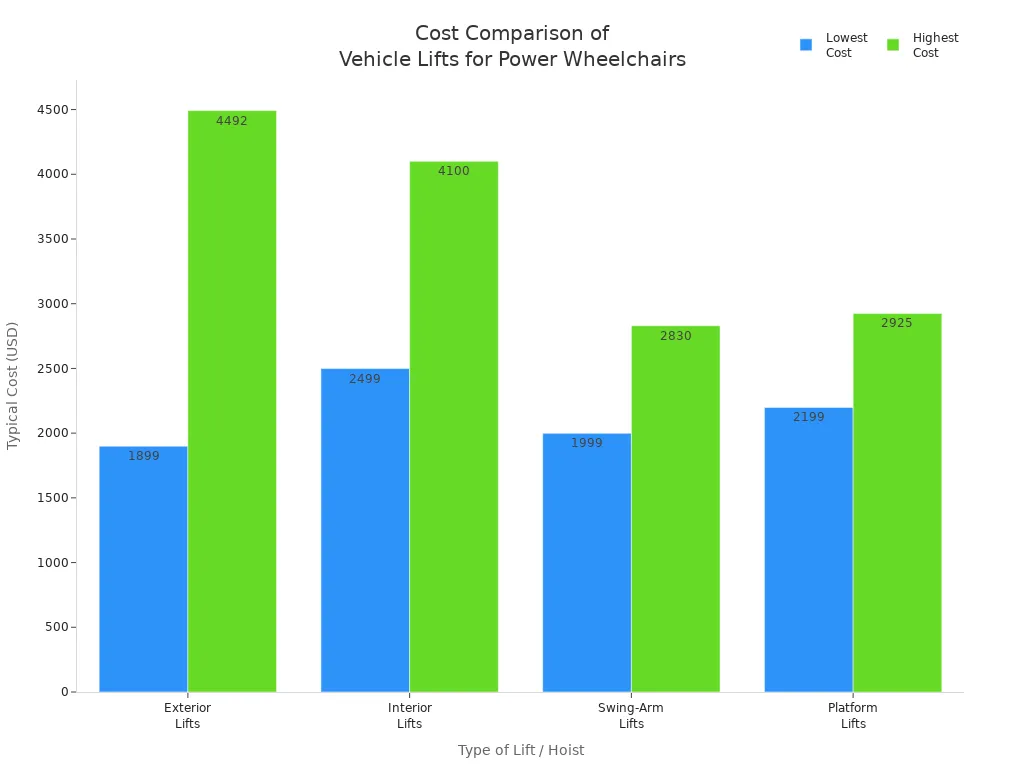
You should pick a lift that matches your wheelchair and your car. Some lifts have automatic folding, power lifting, and weather-resistant features. Always check the weight limit before you buy.
Install and Operate
You need to install your vehicle lift the right way for safety. . If your car does not have one, a dealer can add it. Some lifts, like hoists, need only small changes, such as drilling holes to secure the lift. Most lifts get power from your car’s battery, but some have their own battery.
:
Outdoor platform lifts must be fastened to a concrete pad.
Gates on lifts should have safety locks and fit tightly.
Inclined lifts need rails attached to strong walls or stairs.
You need enough space for the lift to move and for you to board.
Indoor lifts may need a special shaft or pit.
Some lifts need a floor cut-out with a cover.
Regular maintenance keeps your lift working well. Lubricate moving parts and replace worn pieces as needed.
Tip: Always have a professional install your wheelchair lift. This keeps you safe and makes sure the lift works right.
Load and Secure
After you install your vehicle lift, you can load your . Start by parking your car on a flat surface. Open the trunk or rear hatch. Attach the lift’s hook or platform to your wheelchair frame. Use the lift’s controls to raise the wheelchair. Guide it into the car or onto the platform.
Once your wheelchair is inside, secure it with straps or a locking system. Attach straps to the frame, not the wheels. Tighten them so the wheelchair does not move. If your lift has a locking arm, use it for extra safety.
Check all straps and locks before you drive. If you travel in cold or wet weather, check your lift for ice or dirt. Clean and maintain your lift often to keep it safe.
Safety Reminder: Always double-check that your wheelchair is secure before you start driving. A secure wheelchair keeps you and your passengers safe.
Wheelchair-Accessible Van and Other Vehicles
When you want to move your wheelchair, you have many vehicle choices. Each type has different features for moving . Pick the one that matches your needs, your daily life, and your wheelchair.
Using a Wheelchair-Accessible Van
A gives you lots of space and options. These vans have big insides, lower floors, and ramps or lifts that work by themselves. You can roll into the van while sitting in your wheelchair. You do not have to move to a car seat. This makes trips easier and safer for you and your family.
Most vans let you enter from the side or back with ramps. Pick the entry that fits your parking spot and daily plans. Many vans have special straps and locks to keep your wheelchair safe while you ride. Some vans even let you drive while sitting in your wheelchair by using special controls.
🚐 Tip: If you travel with others or need to bring more than one wheelchair, a wheelchair-accessible van is the best pick.
Transporting a Power Wheelchair in SUVs and Sedans
SUVs and sedans are popular cars, but they are different for moving power wheelchairs. SUVs have more room than sedans. They sit higher off the ground and can go on bumpy roads. Some SUVs can get ramps, seats that turn, or systems that lower the car. But, you often have to move from your wheelchair to a car seat in an SUV. This takes arm strength or help from someone else.
Sedans and coupes have the smallest space. Most sedans cannot use ramps or lifts. You must move from your wheelchair to the car seat. Only people who can move by themselves or with help can use sedans for wheelchair trips. Some sedans can use electric wheelchair carriers or special seats, but there are not many choices.
Here is a table to help you compare vehicles for moving power wheelchairs:
| Vehicle Type | Interior Space & Size | Entry Options | Wheelchair Accommodation | Notes |
|---|---|---|---|---|
| Wheelchair-Accessible Van | Spacious, lowered floors | Side or rear-entry ramps/lifts | Stay in wheelchair, no transfer | Best for multiple passengers and easy entry |
| SUV | Moderate, higher clearance | Modified ramps, swivel seats | Usually transfer to car seat | Good for rough roads, some modifications |
| Sedan/Coupe | Limited | No ramps or lifts | Must transfer to car seat | Least expensive, limited accessibility |
Bumper-Mounted Carrier Options
If you have a small car or need more space, a bumper-mounted carrier can help. This device goes on the back of your car. You put your wheelchair on the carrier and use straps to hold it. The SanLi Care Model S300 folds up small, so it fits most carriers. You save room inside your car for people or bags.
Bumper-mounted carriers are good for short drives and quick trips. You do not have to lift your wheelchair very high. Always check if your carrier can hold your wheelchair’s weight. Make sure all straps and locks are tight before you leave.
🛠️ Note: The S300’s light frame and folding design make it great for small cars, SUVs, and even planes. You can take your wheelchair almost anywhere without trouble.
Wheelchair-accessible vehicles give you many ways to travel safely and easily. You can pick a van for full access, an SUV for more uses, or a sedan for simple trips. The SanLi Care Model S300 works well with all these choices, so moving mobility devices is easy and stress-free.
Troubleshooting and Tips
Heavy or Large Wheelchairs
You may find it challenging to transport an electric wheelchair if it is heavy or oversized. Many power wheelchairs weigh more than 100 pounds and have wide frames. When you face this situation, you need to look for the best method of transportation that matches your needs and your vehicle. , can help you move heavy wheelchairs into your car. These lifts attach to your vehicle and use a motor to raise the wheelchair safely. Always check the weight and size limits of your lift before use.
If your wheelchair does not fit inside your car, consider using an exterior lift or a bumper-mounted rack. These options allow you to carry the wheelchair outside the vehicle, saving space inside for passengers or luggage. You can also use a trailer if you need to transport more than one wheelchair or if your wheelchair is extra large. Remember to secure the wheelchair with tie-down straps or a locking system to prevent movement during travel.
Tip: Always measure your wheelchair and your vehicle before buying any lift or rack. This step helps you avoid problems on the day you travel.
Small Car Solutions
Small cars can make transporting a power wheelchair that doesn’t fit inside a car seem difficult, but you have several solutions:
Install a compact vehicle lift, such as a hoist lift or a small platform lift, to help load and unload your wheelchair.
Use portable ramps, like folding or telescoping ramps, which store easily and work well with small vehicles.
Choose an exterior lift that carries the wheelchair outside the car, freeing up interior space.
Secure the wheelchair inside the car with manual tie-down straps or an electronic docking system for safety.
Consider a bumper-mounted rack for lighter wheelchairs or a small trailer as an alternative.
Always check the weight and dimensions of your wheelchair to ensure it matches your chosen lift or ramp. The , with its foldable frame, makes transporting a power wheelchair that fits inside of a car much easier. You can fold it and use a ramp or lift, even in compact vehicles.
🚗 Note: When you transport an electric wheelchair in a small car, plan your route and parking to allow enough space for ramps or lifts.
Solo Loading
Sometimes you need to load your wheelchair by yourself. Solo loading requires careful planning and the right equipment. Start by . Open the trunk or door fully to create enough space. Use a portable ramp or a lightweight lift to help you move the wheelchair without straining your back.
Before you start, inspect your wheelchair for any mechanical issues. Make sure the lift or ramp is in good working order. Place a blanket or mat on the car floor to protect both the wheelchair and the vehicle from scratches. When you load the wheelchair, move slowly and keep your body close to the frame. Use your legs to lift, not your back.
Secure the wheelchair with at least two tie-down straps. Attach the straps to the frame and anchor points in your car. Double-check that the wheelchair does not move before you drive. If possible, practice solo loading at home before your trip. This practice helps you feel confident and safe.
🧑🦽 Final tips for transporting a wheelchair: Regularly check your equipment, plan ahead, and never rush the process. Safety always comes first when you transport an electric wheelchair.
Preventing Damage
You want your wheelchair to stay in good condition during every trip. Damage can happen if you do not load or secure your wheelchair the right way. You can take simple steps to protect your equipment and your car.
Start by checking your wheelchair before you move it. Look for loose parts, worn tires, or anything that might break. Remove any items that could fall off, such as baskets or cushions. Fold your wheelchair if possible. This makes it easier to handle and less likely to get scratched.
When you lift your wheelchair, always use both hands. Hold the frame, not the wheels or moving parts. If you use a ramp, make sure it is stable and has a non-slip surface. Move the wheelchair slowly up the ramp. Do not let it bump into the sides or the car.
Place a soft blanket or mat in your car’s trunk or cargo area. This protects both the wheelchair and your vehicle from scratches. If your wheelchair has sharp edges, cover them with foam or padding. You can also use foam blocks to keep the wheelchair from sliding.
Tip: Always check the area around your wheelchair for sharp objects or hard surfaces. Remove anything that could cause a dent or scratch.
Secure the wheelchair with straps or a locking system. Make sure the straps do not rub against the frame or wheels. Tighten them enough to hold the wheelchair in place, but do not bend or damage the frame. Double-check all straps before you close the trunk.
If you use a bumper-mounted rack, check that the wheelchair sits flat on the platform. Use extra padding if needed. For long trips, stop and check your wheelchair every few hours. Look for signs of movement or damage.
Taking these steps helps you avoid costly repairs. You keep your wheelchair safe and ready for use every time you travel. Good habits make transporting mobility devices easier and safer for everyone.
There are lots of ways to move a power wheelchair safely. First, . that fits your needs. Always use straps or docking systems to keep the chair in place. The is easy to travel with because it folds and has smart features. If you want help, talk to , , or local support groups. If you have questions or want to share your story, leave a comment below!
FAQ
How do you choose the best method for loading a power wheelchair scooter?
You should look at your car size, your strength, and your wheelchair’s weight. Foldable models like the fit many cars. Ramps, lifts, and hoists all help with transporting mobility devices safely.
Can you load a power wheelchair scooter by yourself?
Yes, you can load a lightweight, foldable scooter by yourself. Use a ramp or a small lift for safety. Always secure the wheelchair before driving. Practice solo loading at home to build confidence.
What safety steps should you follow when transporting mobility devices?
Always park on flat ground. Use tie-down straps or a locking system. Check that the wheelchair does not move. Remove loose parts before loading. Double-check all straps and locks before you drive.
Does the SanLi Care Model S300 fit in small cars?
Yes, the SanLi Care Model S300 folds compactly. You can fit it in most car trunks or back seats. Its lightweight frame makes it easy to lift or roll up a ramp.
What equipment do you need for loading a power wheelchair scooter?
You may need a , tie-down straps, a blanket for protection, and possibly a vehicle lift or hoist. Always check that your equipment matches your wheelchair’s weight and size.
How do you prevent damage to your wheelchair and car during transport?