
A power wheelchair is a mobility device designed to help you move with ease using a battery and motor, so you don’t have to use much effort. If you extra support due to conditions like , a power wheelchair can be a great solution. People rely on power wheelchairs for various reasons, including:
Neurological conditions such as multiple sclerosis or ALS
Musculoskeletal disorders like severe arthritis
Injuries or trauma that make walking difficult
A power wheelchair provides greater freedom and independence. If you think you need to be more independent, a power wheelchair can help you achieve that every day.
Key Takeaways
Power wheelchairs have motors and batteries. They help you move without pushing.
They give freedom to people who cannot walk easily. They also help those who find manual wheelchairs hard to use.
There are three main drive types. Rear-wheel is fast. Mid-wheel is good for small spaces. Front-wheel works well outside on rough ground.
You can change your wheelchair with different seats and controls. You can also add accessories for comfort and your way of life.
Doctors and therapists check your needs. They help you pick the best wheelchair and features.
are lighter. They fold up, so travel and storage are easier.
You should take care of your wheelchair often. Knowing how to fix simple problems keeps it safe and working well.
Insurance and funding can help pay for your wheelchair. You need the right papers and a prescription.
Power Wheelchair Basics
What Is a Power Wheelchair
A power wheelchair is a mobility device that uses a battery and motor. You move it with a joystick or other controls. You do not need to push the wheels by hand. This helps if you cannot walk far or have trouble moving. A power wheelchair lets you go inside and outside. It gives you more freedom every day.
The main goal of a power wheelchair is to help you stay independent. You can use it to go to school, work, or see friends. You do not need someone to push you. come in many shapes and sizes. You can pick one that fits your needs and life.
Tip: If walking is hard or you get tired fast, a power wheelchair can help you move around more easily.
Who Needs a Power Wheelchair
You may need a power wheelchair if you have a health problem that makes walking or using a manual wheelchair hard. Doctors and other experts follow steps to see if you need a power wheelchair:
Your doctor writes an order for a power wheelchair.
You meet your doctor for a mobility exam.
Someone checks if your home fits a wheelchair.
The doctor explains what kind of wheelchair you need.
Your problem comes from a nerve, muscle, or bone condition.
A specialist, like a physical or occupational therapist, checks if you need a power wheelchair and writes a report.
The wheelchair company must have a trained expert help you pick the right chair.
You might get a power wheelchair if you have serious problems from ALS, spinal cord injuries, stroke, late-stage Parkinson’s, late-stage multiple sclerosis, cerebral palsy, or muscular dystrophy. If you only have peripheral neuropathy, you may not get one. Some people need special features like tilt, recline, or mounts for medical tools.
Power vs. Manual Wheelchairs
When you pick between a power wheelchair and a manual wheelchair, think about your strength, how far you travel, and what you do each day. Here is a table to help you compare:
| Aspect | Manual Wheelchairs | Power Wheelchairs |
|---|---|---|
| Propulsion | You or a helper must push; needs arm strength | You use a joystick; needs little effort |
| Mobility | Good for short trips and flat places | Good for long trips and rough ground |
| Independence | You need strength or help from others | You can move alone, even with low strength |
| Portability | Easy to fold and carry | Heavier and harder to put in a car |
| Cost | Costs less | Costs more |
| Maintenance | Simple, fewer parts | Needs battery charging and more care |
| Extra Features | Few choices | Many choices like tilt, recline, and custom controls |
Manual wheelchairs are good if you have enough strength and balance. They are easy to move and do not need much care. But you may get tired or hurt your shoulders if you use them a lot. Power wheelchairs do not need any strength to use. You can go farther without getting tired. They have more features, but they are heavier and need their battery charged often.
You might also . Power wheelchairs are for people who need help moving all the time and cannot use a manual wheelchair. are for people who can walk a little and need help mostly outside. Scooters are simple to use, but you must get on and off by yourself and keep your balance. Power wheelchairs give you more support and work well inside and outside.
Note: If you have trouble moving and need help all day, a power wheelchair can give you more freedom than a scooter.
How Power Wheelchairs Work
Motors and Batteries
The heart of every power wheelchair is its motor and battery system. You rely on these parts to move smoothly and safely. The motor gives your chair the strength to climb ramps, cross carpets, and travel outdoors. Most power wheelchairs use electric motors that run quietly and need little maintenance.
The battery stores the energy that powers your chair. Modern power wheelchairs often use lithium-ion batteries. These batteries last longer and weigh less than older types. You can expect a battery to last if you take good care of it. Charging your battery usually takes 4 to 6 hours. Most batteries work best at temperatures between 32°F and 104°F. You should always check your battery level before leaving home.
Here is a quick look at common battery features:
| Battery Attribute | Details |
|---|---|
| Battery Type | Lithium-ion |
| Average Lifespan | 2-3 years with proper care |
| Charging Time | 4-6 hours |
| Voltage | 24V |
| Capacity | 10-20Ah (varies by model) |
| Operating Temperature | 32°F to 104°F (0°C to 40°C) |
Tip: Charge your power wheelchair every night to keep it ready for the next day.
Controls and Joysticks
You control your power wheelchair using a system that fits your needs. The most common way is with a joystick. You push the joystick in the direction you want to go. Some chairs use special controls for people who cannot use their hands. These include head movement sensors, voice recognition, or even brain-computer interfaces.
Here is a table showing different control systems and how they help you:
| Control System Type | Description and Usage | Accessibility Enhancement |
|---|---|---|
| EEG-based Brain-Computer Interface (BCI) | Uses brain signals to control the chair. Good for people with no limb movement. | Lets you drive the chair with your thoughts. |
| Video Camera-based Systems | Tracks body or face movements with a camera. | Lets you steer with gestures or facial cues. |
| Head Movement Sensors | Senses head tilts to give commands. | Helps if you have limited arm or hand movement. |
| Voice Recognition Systems | Listens for spoken commands. | Lets you control the chair hands-free if you can speak clearly. |
| Joystick Controllers | Uses a hand or finger to move a stick. | Easy to use if you have some hand movement. |
| Obstacle Detection Algorithms | Uses sensors to avoid bumps and crashes. | Makes driving safer and more independent. |
| Hybrid Systems | Mixes two or more control types. | Gives you more options and flexibility. |
You can pick the control system that matches your abilities. Many power wheelchairs let you adjust the sensitivity or add extra features. This helps you stay safe and comfortable while moving.
Drive Wheels and Maneuverability
The placement of the changes how your power wheelchair moves. You need to know which type fits your daily life. Some chairs turn easily in small spaces. Others work better outdoors or on rough ground.
Here is a table comparing the main drive wheel types:
| Drive Wheel Placement | Turning Radius | Maneuverability | Additional Notes |
|---|---|---|---|
| Mid-wheel drive | Very tight; turns on the spot | Best for small rooms and tight spaces | Centered wheels; may get stuck on uneven ground |
| Front-wheel drive | Needs less space for L-shaped turns | Good in small areas; climbs obstacles well | Pulls the chair forward; works on soft ground |
| Rear-wheel drive | Wide turns; needs more space | Best for outdoor use and straight paths | Pushes the chair; handles high speeds well |
If you use your power wheelchair mostly indoors, a mid-wheel drive model helps you turn around furniture and corners. For outdoor trips, rear-wheel drive gives you better control on uneven paths. Front-wheel drive works well if you need to climb small curbs or want more leg room.
Note: Always test different drive types before choosing your power wheelchair. This helps you find the best fit for your home and lifestyle.
Safety Features
Your safety matters every time you use a power wheelchair. Modern power wheelchairs come with many built-in safety features. These features help you avoid accidents and keep you comfortable as you move.
Common Safety Features in Power Wheelchairs:
Anti-Tip Wheels: Small wheels at the back or front stop your chair from tipping over. You can go up ramps or over bumps with less worry.
Seat Belts: A seat belt keeps you secure in your chair. It helps you stay in place if you stop suddenly or go over uneven ground.
Speed Controls: You can set a top speed for your chair. Lower speeds help you stay safe indoors or in crowded places.
Automatic Brakes: The chair stops moving when you release the joystick. This feature helps prevent rolling on slopes or hills.
Obstacle Sensors: Some chairs use sensors to detect objects in your path. The chair can slow down or stop to avoid a crash.
Lighting and Reflectors: Lights and reflectors make you visible to others, especially at night or in low light.
Tip: Always check that your seat belt is fastened before you start moving.
Here is a table showing how each safety feature helps you:
| Safety Feature | How It Protects You |
|---|---|
| Anti-Tip Wheels | Prevents tipping on slopes or bumps |
| Seat Belt | Keeps you secure during sudden stops |
| Speed Controls | Limits speed for better control |
| Automatic Brakes | Stops chair if you let go of controls |
| Obstacle Sensors | Warns you or stops for objects ahead |
| Lighting/Reflectors | Makes you visible to cars and people |
You should use these features every time you use your power wheelchair. Check your chair for loose parts or broken safety features. If you notice a problem, contact a service professional right away.
Note: Learning how each safety feature works gives you more confidence and control. Practice using your chair in a safe area before going out in public.
Staying safe means using your chair the right way and keeping it in good shape. When you understand your power wheelchair’s safety features, you protect yourself and enjoy more freedom every day.
Types of Powered Wheelchairs
Rear-Wheel Drive
Rear-wheel drive powered wheelchairs have their drive wheels in the back. These chairs move fast and stay steady on flat ground. They are good if you want speed or need to carry heavy things. Rear-wheel drive models feel stable when you go straight. They are easier to use outside on smooth sidewalks or in big rooms. But turning in small spaces is harder. The turning circle is bigger than other types. If you use your chair in open places or travel far, rear-wheel drive may work well for you. Many people pick this style for shopping or going to appointments because it is strong and lasts a long time.
Mid-Wheel Drive
Mid-wheel drive powered wheelchairs have their drive wheels in the middle. This design lets you turn very easily. You can spin almost in one spot. This helps you move around furniture or in tight hallways. If you live in a small home or need to get through crowded rooms, mid-wheel drive is helpful. A study showed that . Most people pick them because they are great in small spaces. The special suspension system gives you a smoother ride inside and outside. You get a steady base, so you feel safe and balanced. If you want a chair that works in many places, mid-wheel drive is a good choice.
Tip: If you spend lots of time indoors or need to turn fast, mid-wheel drive powered wheelchairs are often the best pick.
Front-Wheel Drive
Front-wheel drive powered wheelchairs have their drive wheels in the front. These chairs are easy to control on rough or bumpy ground. They can climb small curbs and go up slopes better than other types. If you like being outside or need to travel over grass, gravel, or uneven sidewalks, front-wheel drive gives you the power you need. These models also give you more space for your legs. You can stretch your legs out, which feels better for some people. Turning in small spaces is not as easy as with mid-wheel drive, but you still get good control. If you want a chair for outdoor trips, front-wheel drive is a strong choice.
Here is a :
| Drive Type | Performance Characteristics | Terrain Handling & Maneuverability | Ideal Use Cases |
|---|---|---|---|
| Rear-Wheel Drive | Powerful acceleration and speed; stable on flat surfaces | Best for smooth, even ground; robust for daily activities | Users who want speed, strength, and stability on flat areas |
| Mid-Wheel Drive | Balanced maneuverability and stability; compact design | Superior in tight indoor spaces; versatile for many environments | Users who need a chair for both indoor and outdoor use |
| Front-Wheel Drive | Great on slopes and uneven ground; stable and maneuverable | Best for outdoor surfaces like grass, gravel, and sidewalks | Users who are active outdoors and need reliable performance |
Note: Try different powered wheelchair types before you choose. Think about your daily routine and where you use your chair most. This will help you pick the drive type that fits you best. Test each model in real-life places to find what works for you.
Portable and Travel Models
You may want a wheelchair that you can take with you when you travel. of powered wheelchairs make this possible. These chairs help you stay active and independent, even when you are away from home. You can fold or disassemble many of these models, so you can fit them in a car trunk or take them on a plane.
Portable powered wheelchairs weigh less than standard models. Most weigh between 40 and 70 pounds. You can lift them with help or by yourself if you have enough strength. Some models use lightweight frames made from aluminum or carbon fiber. This makes them easier to carry and store.
A is a popular choice for travel. You can fold it in seconds and store it in small spaces. Airlines often allow you to check these chairs as luggage. You should always check with your airline before you fly. Some models come with travel bags or covers to protect them during transport.
Here are some features you might find in portable and travel powered wheelchairs:
Quick-folding frames: You can fold the chair without tools.
Removable batteries: You can take the battery out for charging or to meet airline rules.
Compact size: The chair fits through narrow doors and aisles.
Easy-to-use controls: Simple joysticks help you steer with one hand.
Tip: Always check the weight and folded size of the chair before you buy. Make sure you or your helper can lift it safely.
You may want to compare portable powered wheelchairs before you choose one. The table below shows some important details:
| Feature | Portable Models | Standard Models |
|---|---|---|
| Weight | 40-70 lbs | 100-250 lbs |
| Folding/Disassembly | Yes | Rarely |
| Battery Type | Removable, lightweight | Larger, fixed |
| Travel-Friendly | Yes | No |
| Comfort | Basic | More options |
Portable and travel powered wheelchairs work best for short trips, vacations, or quick errands. You may notice that these models have fewer comfort features than larger chairs. You can still find models with padded seats and adjustable armrests. If you travel often or need a backup chair, a portable model can make your life easier.
Note: Portable powered wheelchairs give you freedom to explore new places. You can enjoy trips with family and friends without worrying about mobility.
Motorized Wheelchair Features
Seating and Adjustability
You sit in your motorized wheelchair for many hours each day. Comfort and support are very important. Modern wheelchairs let you adjust your seat in many ways. You can change the angle, height, and position. This helps your body feel better and keeps you healthy.
The most helpful features are tilt and recline. Tilt lets you move your seat angle without moving the backrest. Recline lets you lean your backrest back almost flat. These features help you relax and change how you sit. They also help stop pressure sores.
Here is a table that shows how tilt and recline work:
| Adjustable Feature | Range / Degree | Purpose / Benefit |
|---|---|---|
| Tilt | 0 to 45 degrees | Gives pressure relief, shifts your weight, and improves comfort. Helps prevent sores. |
| Recline | 90 to 180 degrees | Lets you adjust your backrest for posture changes, rest, and health support. |
Tip: Use tilt and recline often to change your position. This keeps your skin healthy and helps you feel better during long days.
Tilt and recline also help you breathe and keep your blood moving. You can adjust your seat to make eating or reading easier. Some motorized wheelchairs let you save your favorite seat settings. You can change positions with just one button.
Control Systems
You use control systems to drive your motorized wheelchair. The joystick is the most common control. You push it in the direction you want to go. Some chairs have touchpads, switches, or head controls if you cannot use your hands.
These systems are made to be easy for you to use. You can change how sensitive the controls are. Your chair can respond to light or strong touches. Some advanced chairs use voice commands or sensors that follow your head or eyes. These choices give you more freedom and let you move by yourself.
If you have special needs, ask about custom controls. You can find a system that matches your skills and helps you move safely.
Portability
You might want to take your motorized wheelchair when you travel. Many new models are made to be easy to move. They use light materials, so you or your helper can lift them. Some chairs fold up fast, so you can store them in a car or closet.
Here are some common features that help with portability:
that make lifting easier
Foldable designs for quick folding
Small size for moving in tight spaces
Quick disassembly for travel and storage
These features make it easier to visit friends or go on trips. You can move your chair without needing a big van or lots of help. A gives you more choices and freedom every day.
Note: Always check the weight and folding method before you buy. Make sure you can handle the chair or have help when needed.
Battery Life
Battery life is one of the most important things to think about when you use a motorized wheelchair. You want to know how far you can go before you need to charge your chair. Most power wheelchairs use either sealed lead-acid batteries or lithium batteries. Each type gives you a different range and lifespan.
Sealed lead-acid batteries usually let you travel about . These batteries last about 2 to 3 years if you take care of them. Lithium batteries can last even longer. Many lithium batteries work for 3 to 5 years and can help you travel more than 20 miles per charge. This makes them a good choice if you use your chair all day or like to go on longer trips.
Many things can change how long your battery lasts. Your weight and the weight of your wheelchair matter. If you carry heavy bags or go up hills, your battery will drain faster. The type of ground you drive on also makes a difference. Smooth floors use less power than grass or gravel. Speed and temperature can also affect battery life. Cold weather can make batteries lose power more quickly.
Here is a table to help you compare battery types:
| Battery Type | Typical Range per Charge | Lifespan | Notes |
|---|---|---|---|
| Sealed Lead-Acid | 10-15 miles | 2-3 years | Lower cost, heavier |
| Lithium | 20+ miles | 3-5 years | Lighter, longer range |
Tip: Charge your wheelchair every night, even if you did not use it much during the day. This helps your battery last longer and keeps your chair ready to go.
You can make your battery last longer by following a few simple steps:
Keep your battery clean and dry.
Avoid letting your battery run all the way down.
Store your chair in a place that is not too hot or cold.
Use the charger that came with your wheelchair.
If you notice your chair does not go as far as it used to, your battery may need to be replaced. Always check your battery level before leaving home. This helps you avoid getting stuck with a dead battery.
Benefits of Power Wheelchairs
Independence and Mobility
You want to move freely and make your own choices every day. A power wheelchair gives you the autonomy to go where you want, when you want. You do not need to wait for someone to push you or help you get around. This lets you travel to school, work, or the store on your own. You can visit friends, enjoy parks, or take part in community events.
Many people with limited mobility find that powered wheelchairs change their lives. You gain autonomy in daily routines, from getting out of bed to exploring your neighborhood. You can control your schedule and make plans without worrying about physical barriers. This sense of autonomy helps you feel more confident and independent.
Tip: Using a power wheelchair can help you build new skills and discover new places. You can set your own goals and reach them at your own pace.

Comfort and Ease of Use
Comfort matters when you spend hours in your chair. Power wheelchairs offer padded seats, adjustable backrests, and smooth rides. You can change your position with the touch of a button. This helps you stay comfortable all day. Many models let you tilt or recline your seat, which can reduce pressure and help you relax.
Ease of use is another big benefit. You control your chair with a simple joystick or other controls that fit your needs. You do not need strong arms or hands to move. Even if you have limited mobility, you can steer and stop with little effort.
A survey of people with ALS or motor neuron disease who use power wheelchairs showed high satisfaction. At first, . Over time, most users stayed satisfied. Nearly nine out of ten said they would pick the same chair again. This shows that comfort and ease of use last, even after months or years.

Indoor and Outdoor Use
You can use a power wheelchair both inside and outside. At home, you move through doorways, hallways, and tight spaces with ease. Many powered wheelchairs turn in small circles, so you can get around furniture or corners. You can cook, clean, or play with pets without leaving your chair.
Outside, you travel over sidewalks, grass, or gravel. Some models handle hills and ramps with no trouble. You can go shopping, visit parks, or meet friends at a café. This flexibility gives you more autonomy in your daily life. You do not have to worry about missing out on activities because of limited mobility.
You can choose a power wheelchair that matches your lifestyle. Some people need a chair for school or work. Others want a model for outdoor adventures. You decide what works best for you and enjoy more autonomy every day.
Customization
Everyone has different needs and likes. A power wheelchair can fit your life because you can change many things about it. Customization lets you feel safe, comfortable, and independent. You can pick features that help your body, match your daily habits, and show your style.
Why Customization Matters
When you use a wheelchair every day, small changes help a lot. Custom features let you:
Stay comfy for many hours
Stop pain or pressure sores
Move around your house or outside more easily
Use your chair at work, school, or for fun
Show off your personality

Common Customization Options
You can change many parts of your power wheelchair. Here are some popular choices:
Seating: Pick cushions, backrests, and headrests that fit your body. Some seats have memory foam or gel for extra comfort.
Controls: Choose a joystick, touchpad, or head control. Some systems use voice commands or switches if you cannot use your hands much.
Armrests and Footrests: Change the height, angle, or length. Swing-away or flip-up options help you get in and out.
Frames and Colors: Pick a frame size that fits you. Many brands have different colors or patterns so you can show your style.
Wheels and Tires: Pick tires for inside, outside, or both. Some wheels have extra grip for rough ground.
Accessories: Add trays, cup holders, phone mounts, or bags. You can also add lights, mirrors, or oxygen tank holders.
Customization Table
| Feature | Custom Options | Benefit to You |
|---|---|---|
| Seating | Cushions, backrests, headrests | Comfort, posture, skin health |
| Controls | Joystick, touchpad, head/voice controls | Easy driving, independence |
| Arm/Footrests | Adjustable, swing-away, flip-up | Easy transfers, comfort |
| Frame/Color | Size, color, pattern choices | Personal fit, self-expression |
| Wheels/Tires | Indoor, outdoor, all-terrain | Better mobility, safety |
| Accessories | Trays, holders, bags, lights | Convenience, daily living |
How to Get the Right Customization
Start by thinking about your daily life. Ask yourself:
Where do you use your wheelchair most?
Do you need extra support for your back or head?
What controls are easiest for you?
Do you want to carry things with you?
Work with a therapist or wheelchair expert. They can help you try different options. You may need to test a few features before you find what works best.

With the right customization, your power wheelchair is more than just a device. It becomes a tool that helps your health, comfort, and independence every day.
Choosing a Power Wheelchair
Assessing Needs
Choosing the right power wheelchair starts with understanding your unique needs. You want a chair that matches your daily life and supports your autonomy. Here are the main steps you should follow when assessing your needs:
. If you cannot, you may need a power wheelchair for daily mobility.
Make sure you can safely use a power wheelchair or a similar device. Safety is always the top priority.
Think about your ability to sit upright without help and walk short distances. If this is hard, you may need a chair with extra support.
Test your motor control. You need to use a joystick or other controls to drive the chair.
Show that you understand how to stay safe in different places. You should be able to avoid obstacles and respond to changes around you.
Confirm that your vision is good enough to see where you are going and spot hazards.
These steps help you and your care team decide if a power wheelchair is right for you. They also guide you in picking the best features for your situation.

Home and Outdoor Considerations
Your environment plays a big role in choosing powered wheelchairs. You want a chair that fits your home and helps you move outside with ease. Think about these factors:
, missing curb cuts, or bad weather can make it hard to use your chair safely.
Inside your home, stairs and narrow spaces may limit where you can go. Sometimes, people need to change their living space to use a power wheelchair.
can be a challenge. Some chairs are too big for regular cars, and not everyone has funding for vehicle changes.
Many users to improve comfort and function. This helps you adapt to your environment and express your style.
Social and policy issues, such as limited funding or lack of training, can affect your access to the right chair.
Public spaces are not always fully accessible. Sometimes, you may face barriers like backdoor entries or ramps that do not meet your needs.
Learning new skills, such as using public transit, can help you expand your autonomy and use your chair in more places.

Drive System Selection
The drive system affects how your power wheelchair moves and turns. You want a system that matches your lifestyle and supports your autonomy. There are three main types:
Rear-wheel drive: Offers strong performance on flat ground and works well for outdoor use. It gives you stability and speed but needs more space to turn.
Mid-wheel drive: Turns in tight spaces and is great for indoor use. It helps you move around furniture and through narrow halls.
Front-wheel drive: Handles rough ground and small curbs. It gives you more leg room and works well both inside and outside.
Think about where you spend most of your time. If you need to turn in small rooms, mid-wheel drive may be best. If you travel outdoors often, rear-wheel or front-wheel drive could give you more freedom. Trying different models helps you find the right fit for your daily routine.

Professional Assessment
A professional assessment helps you find the power wheelchair that fits your needs. You work with experts who understand mobility and health. These experts include doctors, physical therapists, and occupational therapists. They look at your body, your daily life, and your goals. Their job is to make sure you get a wheelchair that keeps you safe, comfortable, and independent.
Why You Need a Professional Assessment
You may think you know what you want in a wheelchair. A professional can see things you might miss. They check your strength, balance, and posture. They ask about your home, school, or work. They also look at your medical history. This helps them match you with the right chair and features.

Who Takes Part in the Assessment?
You meet with a team of professionals. Each person has a special role:
| Professional | What They Do for You |
|---|---|
| Doctor | Reviews your health and writes a prescription |
| Physical Therapist | Tests your movement and strength |
| Occupational Therapist | Checks how you do daily tasks |
| Assistive Technology Pro | Shows you wheelchair options |
| Wheelchair Supplier | Helps you try different models |
What Happens During the Assessment?
You start by talking about your daily life. The team asks how you move, where you go, and what you want to do. They watch you sit, stand, and use your arms and hands. They may measure your body to find the right seat size. You try different controls, like joysticks or switches. The team checks if you need special features, such as tilt, recline, or extra support.
What You Gain from a Professional Assessment
You get a wheelchair that fits your body and lifestyle.
You learn about new features and technology.
You avoid common problems, such as pain or pressure sores.
You get help with paperwork for insurance or funding.
A professional assessment gives you confidence. You know your wheelchair will support you at home, outside, and everywhere you go.
Cost and Acquisition
Price Range
When you shop for a , you will notice many prices. The price changes based on the type, features, and brand. Some chairs are simple, but others have special technology and custom parts.
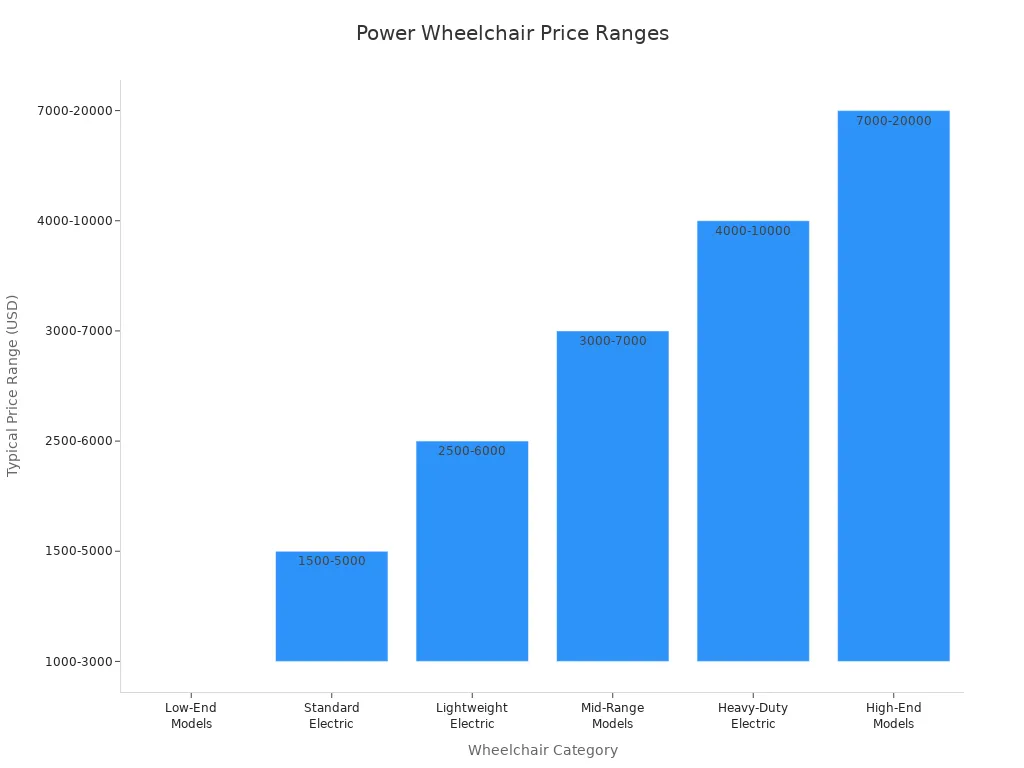
Here is a table that shows the in the United States:
| Price Range Category | Typical Price Range (USD) | Description and Features |
|---|---|---|
| Low-End Models | $1,000 – $3,000 | Basic functionalities, suitable for indoor use and short distances. |
| Mid-Range Models | $3,000 – $7,000 | Balanced features and performance, better battery life, more comfortable seating. |
| High-End Models | $7,000 – $20,000+ | Advanced features like customized seating, superior battery life, durability for varied terrain. |
| Standard Electric Wheelchairs | $1,500 – $5,000 | Includes models with essential features such as adjustable seating and joystick controls. |
| Lightweight Electric Wheelchairs | $2,500 – $6,000 | Designed for portability, made with lightweight materials, generally more expensive than standard models. |
| Heavy-Duty Electric Wheelchairs | $4,000 – $10,000+ | Built for higher weight capacity and rugged terrains, includes reinforced frames and powerful motors. |
You can also look at this chart to compare prices:
Many things can change the final price:
Type of wheelchair (standard, lightweight, heavy-duty)
Features and custom parts (like tilt, recline, or special controls)
Battery life and how much care it needs
Brand name and new technology
How much weight the chair can hold
Insurance and payment plans

Insurance and Funding
Paying for a power wheelchair can seem hard. Insurance and other programs can help you pay less. In the United States, Medicare and some private insurance may pay for part or all of the cost if you follow their rules.
Here is how it usually works:
as manual wheelchair add-ons if you meet certain rules.
You must use a manual wheelchair for at least one year first.
A licensed therapist must check you and write down why you need the device at home.
The wheelchair company must have a certified Assistive Technology Professional (ATP).
You must have trouble moving that makes daily tasks like using the bathroom, eating, dressing, or bathing hard.
A cane or walker must not fix your movement problem.
You must not have enough arm strength to use a manual wheelchair safely.
Your medical records must show your need, your limits, pain, how long you can move, and that you tried the device.
How to Get a Power Wheelchair
You can follow some easy steps to get a power wheelchair:
First, talk to your doctor about your movement needs.
Get a prescription and a full checkup from a physical or occupational therapist.
Work with a wheelchair company that has a certified Assistive Technology Professional (ATP).
Try out different chairs to see which one fits you best.
Send all the needed papers to your insurance or funding group.
Wait for approval, then set up delivery and fitting for your new chair.

Documentation Needed
When you want a power wheelchair, you must gather some important papers. These documents help your doctor, therapist, and insurance company know what you need. If you have all your papers ready, you can get your wheelchair faster.
You will usually need these things:
Doctor’s Prescription Your doctor writes a note for a power wheelchair. This note says why you need the chair every day.
Face-to-Face Evaluation Report You must see your doctor in person. The doctor writes about your health and why you cannot use a manual wheelchair.
Physical or Occupational Therapist Evaluation A therapist checks how strong you are and how you move. The therapist writes a report to show you need a power wheelchair.
Detailed Medical Records You must show your health history. These records list your diagnosis, symptoms, and treatments you tried.
Home Assessment Someone looks at your home to see if a power wheelchair will fit. The report shows if you have enough space or need changes.
Insurance Forms You fill out forms for your insurance company. These forms ask about your health and your doctor’s details.
Supplier’s Letter of Medical Necessity The wheelchair supplier writes a letter for you. This letter explains why the chair you picked is the best choice.
Example Table: Common Documents
| Document Name | Who Provides It? | Why You Need It |
|---|---|---|
| Doctor’s Prescription | Doctor | Shows medical need |
| Face-to-Face Evaluation Report | Doctor | Details your mobility challenges |
| Therapist Evaluation | Physical/Occupational Therapist | Supports your daily needs |
| Medical Records | Doctor/Clinic | Proves your health history |
| Home Assessment | Therapist/Supplier | Checks if your home is accessible |
| Insurance Forms | You/Doctor | Starts the insurance process |
| Letter of Medical Necessity | Wheelchair Supplier | Matches chair features to your needs |
Helpful Reminders
Check that your name and date are correct on each form.
Ask your doctor or therapist if you do not understand something.
Turn in all your papers together so you do not wait longer.
If your insurance wants more information, answer as soon as you can.
Having the right papers helps you get your power wheelchair without trouble. Stay organized and ask for help if you need it. This way, you can focus on being independent and comfortable.
Maintenance and Care
Troubleshooting
You may face problems with your power wheelchair from time to time. Knowing how to troubleshoot common issues helps you stay safe and independent. You can often fix small problems yourself. For bigger issues, you should contact a professional.
Common Problems and Quick Fixes
Here are some problems you might see and what you can do:
| Problem | What You Can Check or Do |
|---|---|
| Chair will not turn on | Check if the battery is charged. Make sure the power switch is on. Look for loose cables. |
| Chair moves slowly | Charge the battery. Check for things blocking the wheels. |
| Joystick not working | Make sure the joystick is plugged in. Restart the chair. |
| Strange noises | Look for objects stuck in the wheels. Listen for loose parts. |
| Chair stops suddenly | Check for error lights. Turn the chair off and on. Make sure the brakes are not locked. |

Step-by-Step Troubleshooting
Check the Battery Make sure your battery has enough charge. Plug in your charger and see if the charging light comes on.
Inspect the Controls Look at the joystick and buttons. Make sure nothing is blocking them. Try moving the joystick in all directions.
Look for Error Codes Some chairs have lights or screens that show error codes. Read your manual to find out what the codes mean.
Examine the Wheels Remove any hair, string, or debris from the wheels. Make sure the tires are not flat.
Test the Brakes Try to move the chair by hand when it is off. If it does not move, the brakes may be locked.
When to Call a Professional
You should call a service expert if:
The chair still does not work after you check the basics.
You see sparks, smoke, or smell burning.
The chair makes loud or strange noises you cannot fix.
The controls do not respond at all.
Troubleshooting helps you solve small problems quickly. You keep your chair working well and avoid bigger repairs. Always keep your manual handy for more help.
Professional Service
Sometimes you need an expert to help with your . You can do easy jobs like wiping it down or checking the battery. But some fixes need a trained person. Getting professional service keeps your power wheelchair safe and working well.
Why You Need Professional Service
Some problems are too hard to fix by yourself. These might be electrical troubles, motor issues, or broken pieces. A certified technician has special tools and knows how to repair these things. Regular check-ups by a pro can stop bigger problems from happening later.
When to Call a Professional
Call a service expert if you notice any of these things:
Your power wheelchair makes odd sounds or shakes.
The controls stop working or act strangely.
The battery will not stay charged, even after care.
The chair moves in a weird way or feels wobbly.
You see parts that are loose, broken, or missing.
Warning lights or error codes show up on the screen.
Trying to fix these problems alone can be risky. You could break the electronics or lose your warranty.
What to Expect During a Service Visit
A technician will:
Look at the frame, wheels, and seat for damage.
Test the battery, motor, and controls.
Check safety parts like brakes and anti-tip wheels.
Tighten bolts and swap out old parts.
Update software if your power wheelchair uses smart controls.
The technician will tell you what they find and explain any repairs. You can ask questions and learn how to care for your chair.
How to Find a Qualified Service Provider
Find a company or person who:
Knows your power wheelchair brand and model.
Has a certificate from a trusted group like RESNA or the maker.
Can come to your home if you cannot visit a shop.
Shares clear prices and warranty details.
Note: Save your service provider’s number in your phone or somewhere safe. This helps you get help fast if you need it.
Professional service helps you feel calm. You know your power wheelchair will stay safe and ready to use. Regular check-ups and expert repairs help you stay active and independent.
A power wheelchair helps you move with ease and gives you more independence. You can choose features that fit your daily life. Always think about your needs and talk to a professional before you decide. Many resources and experts can guide you. If you want to learn more, contact a mobility specialist or look into funding options. You have support every step of the way.
FAQ
How long does a power wheelchair battery last?
Most batteries last 2 to 5 years. You can expect a single charge to last 10 to 20 miles. Battery life depends on your weight, the terrain, and how often you use your chair.
Can you use a power wheelchair outside?
Yes, you can use most power wheelchairs outside. Many models handle sidewalks, grass, and ramps. Always check your chair’s manual to see which surfaces work best for your model.
How do you transport a power wheelchair?
You can fold or disassemble some models for travel. Others need a ramp or lift for a car or van. Portable models fit in most trunks. Ask your supplier for the best option.
What maintenance does a power wheelchair need?
You should clean your chair weekly. Charge the battery every night. Check the tires and controls often. Schedule a professional service once a year to keep your chair safe and reliable.
Will insurance cover a power wheelchair?
Many insurance plans, including Medicare, may help pay for a power wheelchair. You need a doctor’s prescription and proof that you need the chair for daily activities. Check with your provider for details.
Can you customize a power wheelchair?
Yes! You can choose seat cushions, controls, colors, and accessories. Custom options help you stay comfortable and make your chair fit your needs and style.
What should you do if your power wheelchair stops working?
First, check the battery and power switch. Look for loose cables or error lights. If you cannot fix the problem, call a certified technician for help.
Are power wheelchairs safe for children?